Types of Mattresses: How Each One Feels and Who It Suits

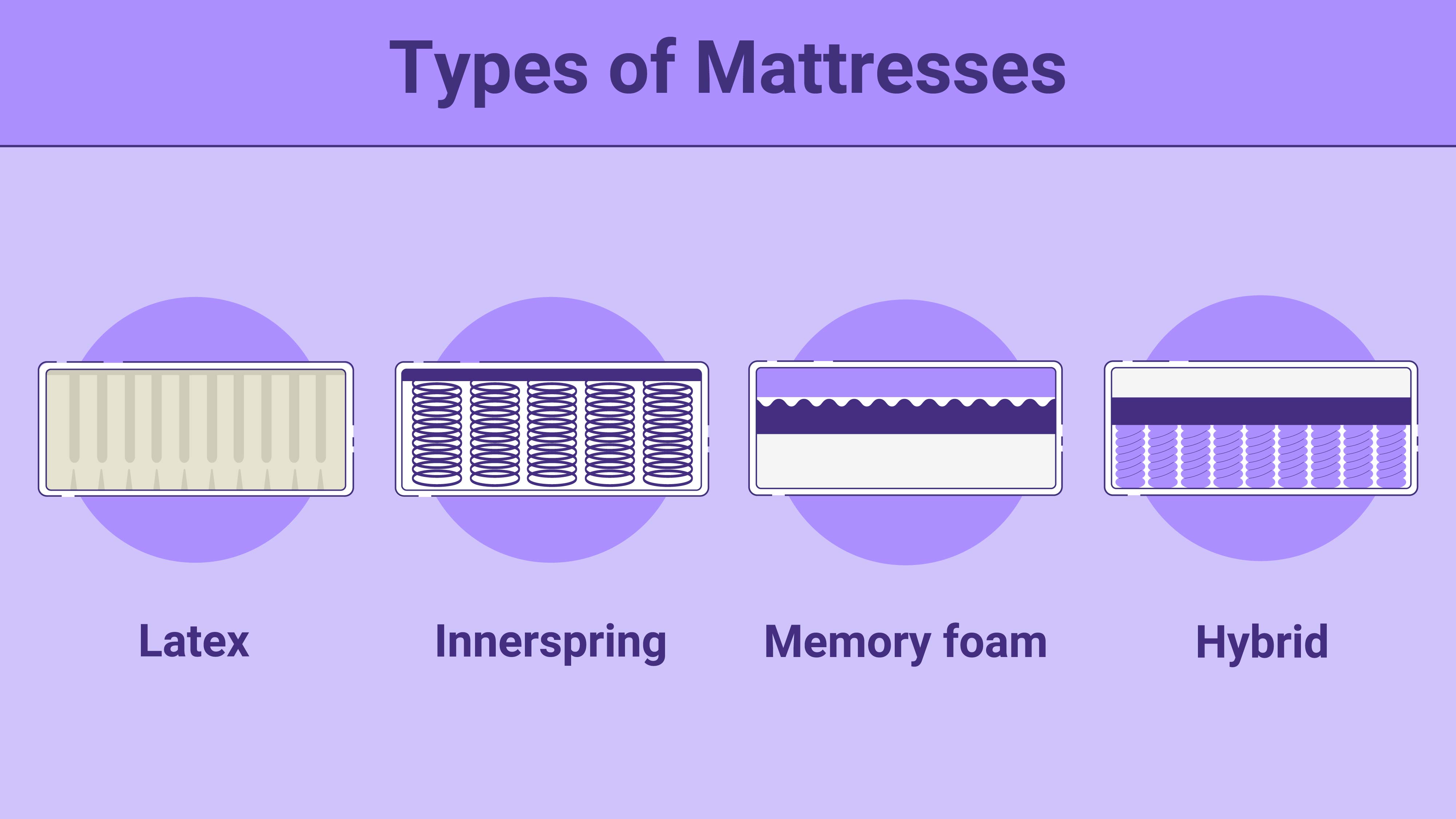
The main types of mattresses are memory foam, latex, hybrid, and innerspring, with airbeds and waterbeds as less common options. Each type uses different materials that change how the bed contours, bounces, handles heat, and lasts, so the right choice depends on your sleep position, body weight, and budget.
Top Recommended Mattress: Amerisleep AS3
For shoppers who prefer the close contouring of memory foam, my top mattress recommendation is the Amerisleep AS3, a memory foam mattress rated 5 to 6 out of 10. Its medium feel falls inside the firmness ranges this guide recommends for side, back, and combination sleepers, so one bed covers the most common positions. In Sleep Junkie’s testing, the shoulders and hips sank in just enough on the side while the midsection stayed supported. It also suits couples who share a bed. It comes with a 100-night trial and a 20-year warranty.
Mattress Types at a Glance
The six mattress types differ mainly in what supports you: foam, rubber, steel coils, air, or water. This table sums up how each is built, how it feels, and its main drawback.
| Type | Built with | How it feels | Main drawback |
|---|---|---|---|
| Memory foam | Layers of viscoelastic polyurethane foam | Slow, close contouring that cradles the body | Can hold heat and feel slow to move on |
| Latex | Natural, synthetic, or blended rubber foam | Springy contouring that lifts you | Natural latex costs more and is unsuitable with a latex allergy |
| Hybrid | Foam comfort layers over pocketed coils | Cushioning on top with bounce underneath | Price and feel vary widely with the foam used |
| Innerspring | Steel coil core under a thin comfort layer | Firm and bouncy, on top of the bed | Less pressure relief and motion isolation |
| Airbed | Adjustable air chambers, usually under foam | Firmness you change with a remote or app | Costly, with pumps and chambers that can fail |
| Waterbed | Water-filled bladder inside a frame | Fluid and conforming | Leaks, heavy weight, and draining to move |

Memory Foam Mattresses
Memory foam mattresses use layers of viscoelastic polyurethane foam that soften under body heat and pressure, so the surface molds closely to your shape. Memory foam is denser than standard polyfoam and responds by contouring rather than springing back, which gives it a hugging, sink-in feel. For a closer look at the material itself, see what memory foam is and how it works.

Newer foams target the complaints about early memory foam, which could trap warmth and carry a noticeable new-foam smell, called off-gassing. Gel memory foam adds gel beads meant to draw heat away from the surface, some foams add conductive materials such as copper or graphite, and plant-based foams replace part of the petroleum-based oils with plant oils. Look for CertiPUR-US certification, which means the foam was tested by independent labs for content, emissions (low VOC), and durability.
Memory foam tends to suit side sleepers and couples. Its contouring spreads pressure at the shoulder and hip, and the dense foam absorbs movement, so a partner’s tossing is less likely to reach your side. It is also widely available at relatively low prices. Hot sleepers and people who change positions often may prefer a faster, more breathable type, and the guide to the best memory foam mattresses compares current options.
Latex Mattresses
Latex mattresses use foam made from rubber: natural latex from the sap of the Hevea brasiliensis rubber tree, synthetic latex, or a blend of the two. Latex contours like memory foam but has a natural springiness, so it lifts you rather than letting you sink in and responds quickly when you change positions.

Natural latex comes in two main forms. Dunlop latex is poured into a mold and cured in one pass, so it tends to be denser at the bottom, while Talalay latex is vacuum-expanded and flash-frozen before curing, which gives it a more even, airy feel. Both can be made soft or firm, and the guide to Dunlop and Talalay latex compares them in detail.
Synthetic latex is usually made from styrene-butadiene rubber (SBR). It tends to be less buoyant and less durable than natural latex and can carry a stronger chemical odor at first, and blended latex falls somewhere between the two. For the springy feel and longevity latex is known for, choose natural Dunlop or Talalay, which tend to have minimal off-gassing.
Latex tends to suit combination sleepers who want a responsive surface, heavier sleepers who sink too far into softer foam, and shoppers who want natural materials. Natural latex is also durable, lasting up to 12 years in some cases, and because rubber trees are tapped rather than cut down, it is a common choice among sustainable mattresses. GOLS certification means the latex was made with at least 95 percent certified organic raw material.
Natural latex tends to resist dust mites and mildew, one reason it often appears among the best mattresses for allergies, though anyone with a latex allergy should avoid it. To compare specific beds, see the best latex mattresses.
Hybrid Mattresses
Hybrid mattresses pair foam comfort layers, usually memory foam or latex, with a steel coil support core. The goal is foam’s cushioning at the shoulder and hip plus the bounce and airflow of springs, and the guide to what a hybrid mattress is covers the construction in depth.

Most hybrids use pocketed coils, which are individually wrapped so each spring moves on its own. That lets the support core respond to different parts of the body and limits how far movement travels, which is why hybrids often turn up among the mattresses for motion isolation. The open space around the coils also lets air move more freely than a solid foam base.
Hybrids tend to suit couples, combination sleepers, and anyone who likes some bounce but still wants cushioning. Most have at least 2 to 3 inches of foam on top and come in firmness levels from medium-soft to firm. When comparing them, look for a top layer of high-quality memory foam or natural latex over pocketed coils, and browse the best hybrid mattresses to see current picks.
Innerspring Mattresses
Innerspring mattresses use a steel coil support core under a relatively thin comfort layer of foam, cotton, or wool. They are the oldest common type, with a firm, bouncy feel that keeps you on top of the bed rather than in it.

The coil design changes how an innerspring feels:
- Bonnell: Hourglass-shaped coils, wider at the ends than in the middle, laced together. They are common in lower-priced beds and tend to feel firm and springy.
- Offset: Hourglass coils with flattened, squared-off tops that hinge together, letting the surface contour a little more than Bonnell coils.
- Continuous: Rows of S-shaped springs formed from one length of wire, which spreads weight across neighboring springs and tends to feel firm.
- Pocketed: Individually wrapped coils, the same kind used in most hybrids, found in some innersprings.
Coil gauge describes wire thickness: the lower the number, the thicker and firmer the wire, and most mattress coils fall between about 12 and 15 gauge. Coil count rises with mattress size, so compare counts only between beds of the same size.
Innerspring beds tend to suit budget shoppers, people who like a firm, bouncy surface, and warm sleepers, since the thin comfort layer leaves little foam to hold heat above the open coils. They usually cost less than foam, latex, or hybrid beds, but many last around six years, while well-made foam, latex, and hybrid beds often last 8 to 12 years. If price matters most, start with the guide to the best budget mattresses.
The thin comfort layer can feel hard under the shoulder and hip for side sleepers. A pillow top mattress, an innerspring with extra padding sewn to the top, adds cushioning, and the guide to the best innerspring mattresses compares current options.
Airbeds
Airbeds, also called adjustable air mattresses, use air chambers that a pump inflates or deflates to change the firmness, usually controlled with a remote or app. They are very different from an inflatable camping mattress: the chambers typically sit beneath foam comfort layers, so the bed looks and feels much like a standard mattress.
Airbeds tend to suit couples who want a different firmness on each side, since some models have a separate chamber for each side, and people whose comfort needs change over time. The trade-offs are cost and upkeep: they are among the most expensive types, and pumps, hoses, and chambers can fail. If you buy one, choose a warranty that covers both the mattress and the pump.
Waterbeds
Waterbeds use a water-filled bladder, set inside a frame or foam surround, that conforms closely to the body and spreads weight evenly. They peaked in popularity in the 1970s and 1980s but are still sold in three main styles:
- Free-flow: No internal baffles, so the water moves freely and motion is most noticeable.
- Semi-waveless: Some baffles inside calm the water and reduce motion.
- Waveless: More baffling keeps motion minimal, closer to the feel of a standard mattress.
The drawbacks are practical. Leaks can be hard to repair and can damage the room, a filled waterbed is very heavy, and it has to be drained before it can be moved.
How to Choose a Mattress Type
Choose a mattress type by the feel you want and the drawbacks you can live with, then choose the firmness by your sleep position and body weight. Start with whether you like to sink in, float on top with some bounce, or adjust the feel yourself, and the type sections above will narrow the field.
Whichever type you choose, buy with a sleep trial of at least 90 days so you have time to adjust to the new surface and return it if it is wrong. If comfort across positions is your top priority, the most comfortable mattress guide is a useful next stop, and if back discomfort is part of why you are shopping, see the guide to the best mattresses for back pain.
Firmness by Sleep Position
Whatever type you pick, firmness decides whether your spine stays close to neutral. Sleep Junkie rates firmness from 1 (softest) to 10 (firmest), and the mattress firmness scale guide explains each level.
| Sleep position | Firmness | Scale | Why |
|---|---|---|---|
| Side | Medium-soft to medium | 3 to 6 | Lets the shoulder and hip sink in so the spine stays level |
| Back | Medium to medium-firm | 5 to 8 | Keeps the hips from sinking below the shoulders |
| Stomach | Medium-firm to firm | 7 to 10 | Stops the hips from dipping and arching the lower back |
| Combination | Medium to medium-firm | 5 to 8 | Balances cushioning and support and makes turning over easier |
These ranges assume a sleeper of about 130 to 230 pounds. If you weigh under 130 pounds, go one step softer; if you weigh over 230 pounds, go one step firmer, and the guide to the best mattress for heavy sleepers covers beds built for more weight. If you are torn between two levels, the firm vs. soft mattress comparison walks through the trade-offs.
To compare picks by position, see the best mattresses for side sleepers, the best mattresses for back sleepers, the best mattresses for stomach sleepers, or the best mattresses for combination sleepers. If you land on memory foam in the medium range, the Amerisleep AS3 is rated 5 to 6 out of 10, inside the shared range for side, back, and combination sleepers.
Bottom Line
There is no single best type of mattress: memory foam cradles, latex lifts and responds, hybrids blend foam and coils, and innersprings stay firm, bouncy, and affordable, while airbeds and waterbeds serve narrower needs. Pick the type whose feel and drawbacks suit you, then match the firmness to your sleep position and weight. For side, back, and combination sleepers who settle on memory foam, the Amerisleep AS3 is a medium option to start with. When you are ready to compare specific beds, start with the best mattresses across every type.
Frequently Asked Questions
How many types of mattresses are there?
There are four main types of mattresses: memory foam, latex, hybrid, and innerspring, plus two less common types, airbeds and waterbeds. Each category also has subtypes, such as gel or plant-based memory foam, Dunlop or Talalay latex, and memory foam or latex hybrids, so the number of distinct options is larger than the core four.
What type of mattress is best?
No single mattress type is best for everyone, because the right one depends on your sleep position, body weight, temperature preference, and budget. Memory foam fits people who like a close cradle, latex fits people who want a responsive, natural build, hybrids fit people who want foam with bounce, and innersprings fit firm-bed fans shopping on a budget.
Which type of mattress lasts the longest?
Natural latex usually lasts the longest, often up to around 12 years. Well-made memory foam and hybrid beds commonly reach 8 to 12 years, while a traditional innerspring tends to wear out first, often after about six years. Build quality matters as much as type, since denser foams and natural latex generally hold their shape longer than lower-grade materials.
What type of mattress is best for side sleepers?
Side sleepers usually do best on memory foam, latex, or a hybrid in the medium-soft to medium range, about 3 to 6 out of 10. Those types let the shoulder and hip sink in far enough to keep the spine level. Traditional innersprings are often a weaker fit, because their thin padding can feel firm at the shoulder and hip.
How much do different types of mattresses cost?
Innerspring mattresses are usually the least expensive type, and all-foam memory foam beds are often available at relatively low prices. Hybrid prices vary with their comfort layers, and latex hybrids typically cost more than memory foam hybrids. All-latex beds cost more still, especially certified organic latex, and adjustable airbeds tend to be the most expensive type.
Related Reads
- I Tested 50+ Mattresses to Find the 14 Best Mattresses for Menopause of 2026


- I Tested 50+ Mattresses to Find the 14 Best Mattresses for Piriformis Syndrome of 2026

- I Tested 50+ Mattresses to Find the 14 Best Mattresses for Neuropathy of 2026


- I Tested 50+ Mattresses to Find the 14 Best Mattresses for Kyphosis of 2026