
Sleep Junkie tests pillows using the same hands-on approach we apply to mattresses. Kristina Hindes, our lead pillow tester, scores every pillow in four categories: value, cooling, shape retention, and care and cleaning. She also evaluates adjustability, support, loft, pressure relief, and construction on every pillow. Those five shape the recommendation and the sleeper fit guidance without carrying a score of their own, because they describe what kind of pillow it is rather than how good it is. She tests…

Every mattress featured on Sleep Junkie is evaluated using the same testing framework for support, pressure relief, cooling, motion isolation, edge support, responsiveness, and overall value. Learn How We Test Mattresses.
Finding the right pillow should not require guessing which marketing claims are real. Sleep Junkie uses a consistent hands-on testing process to evaluate every pillow we recommend, and we have put 13 pillows through that process so far. Every pillow named in our guides has been tested. We do not rank a pillow we have not slept on.
How We Test Pillows at Sleep Junkie
Our pillow testing process scores four categories: value, cooling, shape retention, and care and cleaning. We evaluate five more areas on every pillow without scoring them: adjustability, support and neck alignment, loft and height, pressure relief, and construction. Those five decide which sleepers a pillow suits rather than how good the pillow is, which is why they inform our fit guidance instead of carrying a number. Kristina tests each pillow herself, in every sleeping position, and compares it side by side against the other pillows in the same testing session.
Testing observations come first. We check the manufacturer specifications afterward, and where a spec and what we observed disagree, we say so rather than repeating the spec. We revisit our findings as products change and as long term owner feedback accumulates.
Sleep Junkie uses hands-on product evaluation, product-spec review, owner-feedback review where available, and input from our expert review board where applicable.
Health related content is routed to a credentialed reviewer when the topic calls for clinical oversight. Where a page has been medically reviewed, the reviewer is named directly under the author byline so you can see who checked it.
Why Trust Sleep Junkie
Sleep Junkie evaluates pillows using a consistent testing framework that scores four categories: value, cooling, shape retention, and care and cleaning. Testing is led by Kristina Hindes, MSW, LCSW, Certified Sleep Coach, with health-related content reviewed by our Expert Review Board. Our recommendations come from hands-on testing and expert review, not from manufacturer claims.
Testing At A Glance
Hands-On Pillow Testing
Every pillow is evaluated using the same testing framework, allowing us to compare products on consistent criteria rather than marketing claims.
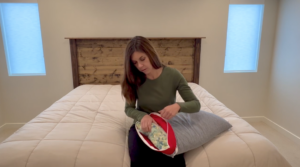
Multiple Sleeping Positions
We test pillows while sleeping on our side, back, and stomach to understand how well they support different sleeping styles.
Expert Reviewed
Dr. Jennifer Miller, PT, DPT, reviews our sleep and health-related content for accuracy, so the recommendations stay evidence based and the claims stay within what testing actually supports.

Evidence-Based Recommendations
Rankings come from testing, side by side comparison, and real world performance. They are not influenced by advertising relationships or manufacturer claims.
Meet The Sleep Junkie Testing Team
Our pillow recommendations are backed by hands-on testing, research, and expert review.
Kristina Hindes, MSW, LCSW
Lead Pillow Tester & Certified Sleep Science Coach
Kristina runs Sleep Junkie’s pillow testing program. She scores every pillow on value, cooling, shape retention, and care and cleaning, and evaluates adjustability, support, loft, and pressure relief position by position to decide which sleepers each pillow suits. She tests each one in the side, back, and stomach positions and films the session.
Dr. Jennifer Miller, PT, DPT
Medical Reviewer
Dr. Miller reviews sleep and health-related content for accuracy and claim safety, helping ensure recommendations remain evidence-based and medically responsible.
How Our Testing Process Works
Step 1: Pillow Arrival & Initial Inspection
We document pillow construction, materials, loft, firmness, adjustability, and any unique features.
Step 2: Construction & Materials Review
We examine fill materials, cover fabrics, adjustability features, and overall build quality.
Step 3: Hands-On Testing
We test pillows across multiple sleeping positions and performance categories.
Step 4: Performance Scoring
Each pillow receives scores across our core testing categories.
Step 5: Side-by-Side Comparisons
We compare pillows against competing models to better understand strengths and weaknesses.
Step 6: Category Winner Selection
We identify which pillows perform best for specific sleeper needs.
Step 7: Review Publication & Updates
Findings are published and reviewed periodically as products evolve.
Our Pillow Testing Categories
Support & Neck Alignment Testing
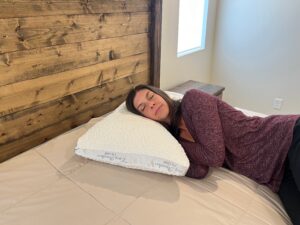
A pillow’s main job is to hold the head and neck in line with the rest of the spine. We test that position by position. On the side, we check whether the head stays level with the spine or tips down toward the shoulder. On the back, we check whether the chin is pushed toward the chest by too much loft or whether the head falls backward from too little. On the stomach, we check whether the neck is lifted out of line.
Why Support Matters
Loft that is wrong for a sleeping position changes the angle of the head and neck, and that is the most common reason a pillow feels wrong within the first few minutes.
What We Look For
- Where the head sits in the side, back, and stomach positions
- Whether the head stays level with the spine or tilts out of line
- How far the surface collapses under the weight of the head
- Whether that support holds after the head has rested in one place for several minutes
- How the pillow behaves when a sleeper changes position mid test
Loft & Height Evaluation
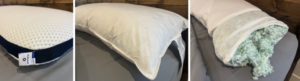
Loft is the height of the pillow. We measure it twice: once uncompressed out of the bag, and again with the full weight of the head on it, because the second number is the one that decides how a pillow actually feels. Different sleeping positions need different loft, so we record both numbers against each position rather than reporting a single figure.
Why Loft Matters
The gap between the head and the mattress is wider for a side sleeper than for a stomach sleeper, so the same pillow can work well in one position and badly in another. Loft is usually the reason a pillow that suits one sleeper does not suit their partner.
What We Look For
- Uncompressed loft measured against loft under head weight
- Which sleeping positions the measured loft actually suits
- Whether the loft suits a sleeper as delivered, before any adjustment
- How evenly the loft sits across the pillow rather than only at the center
- Whether the height holds after weeks of use
Adjustability Testing
Adjustability is whether a pillow can be changed to fit you, and how far it will actually go. We open every pillow that opens, remove fill, put it back, and measure the loft at each stage. A pillow that claims to adjust but only moves half an inch is not adjustable in any way that matters to a sleeper whose neck needs a different height. We report adjustability as a stated spec rather than a score, because a fixed pillow is not a worse pillow. It is a different kind of pillow, and the trait that makes it fixed is usually the same trait that helps it hold its shape.
Why Adjustability Matters
Loft is the single thing most likely to make a pillow wrong for a given sleeper, and an adjustable pillow is the only kind that can be corrected after it arrives. It also covers the sleeper who changes positions during the night, and the shopper who is buying without trying.
What We Look For
- Whether fill can be removed and added, or only pushed around inside
- How much the measured loft actually moves between the fullest and emptiest settings
- Whether the brand supplies somewhere to store fill that has been taken out
- How long an adjustment takes and how messy it is
- Whether the pillow holds the setting or drifts back over the following nights
Pressure Relief Testing
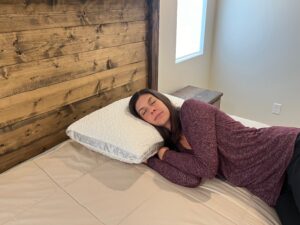
We check how the surface responds to concentrated weight at the ear, the jaw, and the back of the head, and whether the shoulder finds room when side sleeping. Firm foam that does not give at the ear tends to show up within a few minutes; overly soft fill tends to show up as the head bottoming out onto the mattress underneath.
Why Pressure Relief Matters
The head is heavy and rests on a small contact area, so a surface that will not yield at the ear or that collapses entirely under the head is noticeable quickly.
What We Look For
- How the surface gives at the ear and jaw when side sleeping
- Whether the head bottoms out and contacts the mattress underneath
- How much room the shoulder has alongside the pillow
- How the fill distributes weight across the contact area rather than bunching
- How the surface responds when the head is moved to a fresh spot
Cooling & Temperature Regulation Testing
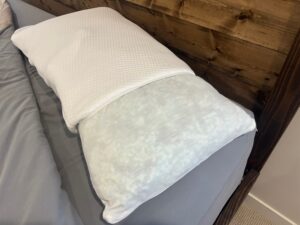
We compare surface temperature by touch at first contact, then again after the head has rested in one spot, and we compare each pillow against the others tested in the same session rather than against a claim on the box. Solid foam, shredded fill, down, and latex behave differently here, and testing them back to back is the only way to say which one held less heat. Across the pillows we have tested so far, that comparison produced a result worth reporting plainly: none of them ran hot, and the differences between them were too small to separate honestly. They all score the same on cooling as a result. We would rather publish that than invent a ranking we did not observe.
Why Cooling Matters
Heat builds up faster at the pillow than almost anywhere else on the bed, because the head has a small contact area and stays in one place. A pillow that traps heat is a common reason for flipping to the cool side.
What We Look For
- How the cover feels to the touch on first contact
- How much warmer the same spot feels after extended contact
- How that compares against the other pillows tested in the same session
- Whether the fill allows air to move through it or holds heat in place
- Whether cooling covers and ventilation channels change anything we can actually feel
Shape Retention Testing
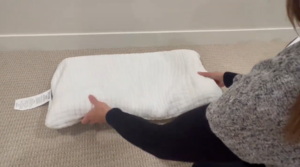
We compress the pillow by hand and by head weight and watch how it comes back, then check the same pillow again after extended use to see whether the loft it started with is the loft it kept. Shredded fill, solid foam, latex, and down each fail differently: shredded fill migrates and clumps, down flattens, foam softens.
Why Shape Retention Matters
A pillow that loses its shape loses the loft that made it work for a sleeping position in the first place. This is usually what people mean when they say a pillow “went flat.”
What We Look For
- How quickly the surface returns after compression
- Whether fill migrates toward the edges or clumps in the center
- Whether fluffing restores the original loft or only part of it
- How much loft the pillow has lost after extended use
- Whether the fill can be redistributed by hand or has permanently shifted
Construction & Materials Evaluation
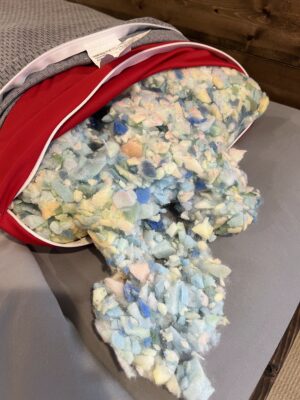
Before testing performance, we open the pillow up. We unzip the cover where it unzips, handle the fill, and note what is actually inside against what the brand says is inside. The point is not to catalogue the materials. It is to have an explanation ready for whatever the pillow does later in testing.
Why Construction Matters
Fill type is the strongest predictor of how a pillow will behave under the head and how it will hold up, so knowing what is inside makes the testing results easier to interpret.
What We Look For
- Fill type, and whether it matches what the brand states
- Cover fabric and how much stretch it has under the head
- Zipper, seam, and stitching quality at the points that take stress
- Whether the fill is accessible for adjustment
- Certifications held, and what those certifications actually cover
Care and Cleaning Testing
We read the care label on every pillow and check it against how the pillow is built. Three things decide the score: whether the whole pillow can go in a washing machine, whether only the cover can, or whether it is spot clean only. Very few pillows are fully washable, and the difference matters more over a few years than most shoppers expect at the point of purchase.
Why Care and Cleaning Matters
A pillow absorbs sweat, oils, and hair every night, and it sits directly under your face. A pillow that cannot be washed depends entirely on a pillowcase and a protector, and it will usually be replaced sooner than one that can be cleaned properly.
What We Look For
- Whether the entire pillow is machine washable, or only the cover, or neither
- How easily the cover comes off and goes back on
- Whether the care instructions rule out a dryer
- Whether the fill recovers its loft after washing or comes back clumped
- Whether the brand requires a protector to keep the warranty intact
Value Assessment
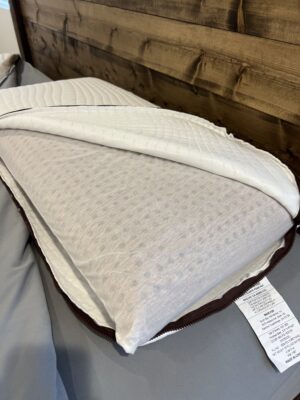
Durability only shows up over time, so we combine what we observe during extended use with the fill type, the warranty terms as written, and long term owner feedback where enough of it exists. Value is judged against what the pillow does in testing and how long it holds up, not against the sticker price alone.
Why Value Matters
A cheap pillow that flattens in six months costs more per year than a more expensive one that holds its loft, so durability and price have to be read together rather than separately.
What We Look For
- Cost per year of use, weighed against how long the fill is likely to last
- Warranty length and what the terms actually cover
- Whether a sleep trial is offered and how long it runs
- Long term owner feedback where a meaningful volume of it exists
- Whether the pillow is sold in more than one size, and what each one costs
HOW WE SCORE PILLOWS
After testing is finished, each pillow is scored from 1 to 10 in four categories. The overall score is the average of those four. We score every pillow the same way, which is what makes the numbers comparable from one guide to the next.
We deliberately do not score adjustability, support, loft, pressure relief, or construction. Most are questions of fit rather than quality: a low loft pillow is excellent for a stomach sleeper and wrong for a side sleeper, and collapsing that into one number would hide the thing a shopper most needs to know. Adjustability sits in the same bucket for a different reason. A pillow with a fixed core cannot be adjusted precisely because it is solid, and that same solidity is what helps it hold its shape, which we already score. Counting it twice would penalize a pillow for the trait we just credited. Construction is examined on every pillow because it explains the scores rather than being one.
You will notice every pillow carries the same cooling score. That is deliberate. None of the pillows we tested ran hot, and the differences between them were too small to rank honestly, so we report them as equal rather than manufacturing a spread. Cooling is not the thing to shop on with these pillows, and we would rather say so.
Scores are set by what the pillow did in testing. We do not adjust a score to justify a ranking, and we do not move a number because a pillow is popular or because a brand is an advertiser. Where a pillow scores poorly in a category, that score stays on the page alongside the recommendation.
Categories We Score
- Value
- Cooling
- Shape Retention
- Care & Cleaning
How We Report Fit
Support, loft, and pressure relief are not scored, because they are questions of fit rather than quality. A five inch pillow is excellent for a stomach sleeper and wrong for most side sleepers, and there is no honest way to turn that into a single number. Adjustability sits alongside them for the same reason.
So we report fit directly instead. Every pillow we test is rated in all three sleeping positions, based on where the head sat relative to the spine in each one. Excellent means the pillow held the head in line without adjustment. Good means it worked, with a caveat or an adjustment. Not Recommended means the loft pushed the head out of line in that position, and a different pillow is the better answer.
| Pillow | Adjustable | Side | Back | Stomach |
|---|---|---|---|---|
| Amerisleep Comfort Classic | No | Excellent | Good | Not Recommended |
| Amerisleep Flex | Yes | Excellent | Excellent | Good |
| Amerisleep Dual Comfort, Mid Loft | Partial | Excellent | Good | Not Recommended |
| Amerisleep Dual Comfort, Low Loft | Partial | Good | Excellent | Good |
| Vaya Pillow | No | Excellent | Good | Not Recommended |
| Zoma Pillow | Yes | Good | Excellent | Good |
| Birch Organic Pillow | No | Good | Excellent | Good |
| Helix Down Pillow | No | Not Recommended | Good | Excellent |
| Bear Adjustable Pillow | Yes | Excellent | Excellent | Good |
| Nest Bedding Easy Breather | Yes | Excellent | Excellent | Good |
| Nest Bedding Easy Breather Side Sleeper | Yes | Excellent | Good | Not Recommended |
| Nest Bedding Easy Breather Jr. | Yes | Sized for children. Rated within our kids guide rather than against adult pillows. | ||
| Zoma Body Pillow | Yes | A body pillow, used alongside a head pillow rather than instead of one. | ||
Two things this table makes obvious. An adjustable pillow is rarely wrong for anyone, because the loft can be corrected after it arrives. And a fixed pillow that is excellent in one position is often the wrong pillow in another, which is why the same product can top one of our guides and be absent from the next.
This is also why our category winners are not simply the pillows with the highest overall scores. A stomach sleeper needs low loft far more than a high average, and the table above is what decides that, not the number.
HOW WE CHOOSE CATEGORY WINNERS
Different sleepers need different things, so we name a winner for each of them rather than a single pillow for everyone.
The pillow that wins a category is the one that performed best for that specific need, not automatically the one with the highest overall score. The four scored categories measure how good a pillow is. They do not measure who it is for. A pillow can win Best Pillow for Side Sleepers on loft and shoulder room while another pillow on the same page carries a higher average, because fit is decided by what we observed position by position rather than by the average. When that happens we say so on the page and name the observations that decided it. We never move a score to make a ranking look tidier.
The pillow with the strongest performance across all four scoring categories, with no serious weakness in any of them.
Pillows whose loft held the head level with the spine on the side, with room for the shoulder alongside.
Pillows built with the fills and covers that move heat best, chosen for hot sleepers on construction and fit rather than on a cooling ranking, since none of the pillows we tested ran hot.
Pillows that held the head in line with the spine without collapsing under its weight or pushing the chin out of position.
No single pillow wins every category, and any guide that tells you otherwise is not testing. Every pillow we recommend carries a stated limitation alongside its strengths, and a named alternative on the same page for the sleepers it does not suit.
FREQUENTLY ASKED QUESTIONS
How does Sleep Junkie test pillows?
Every pillow is tested in the side, back, and stomach positions and scored in four categories: value, cooling, shape retention, and care and cleaning. We also evaluate adjustability, support, loft, pressure relief, and construction without scoring them, because those decide which sleepers a pillow suits rather than how good it is. We measure loft both uncompressed and under head weight, compare surface temperature against the other pillows tested in the same session, and check shape retention after extended use rather than only on the first night.
Who actually tests the pillows?
Kristina Hindes, MSW, LCSW, Certified Sleep Coach, tests every pillow personally and films the sessions. She is the named author on our pillow guides and the tester behind the observations in them. Where a guide covers a health related topic, Dr. Jennifer Miller, PT, DPT, reviews it for accuracy and is credited by name directly under the byline.
Do you recommend pillows you have not tested?
No. Every pillow ranked in a Sleep Junkie guide has been tested hands on. Our guides may explain fill types or pillow shapes we have not tested as background information, but a pillow does not appear as a ranked recommendation unless it has been through the full testing process and scored.
How are pillows scored?
Each pillow is scored from 1 to 10 in each of the four scored categories, and the overall score is the average of those four. The same framework is applied to every pillow, which is what makes the scores comparable across guides. Scores reflect what happened in testing and are never adjusted to support a ranking or a brand relationship.
What makes a pillow win a category?
A category winner is the pillow that performed best for that specific need, not automatically the one with the highest overall score. A side sleeper guide is decided mostly by whether the loft held the head level with the spine and left room for the shoulder, which we assess position by position rather than score. A cooling guide is decided on construction and fit rather than on a temperature ranking, because none of the pillows we tested ran hot and they scored the same on cooling as a result. When a lower ranked pillow carries a higher average, we explain what we observed that decided the category.
How often are rankings updated?
We revisit rankings as brands change their products, as we test new pillows, and as long term owner feedback accumulates on the ones we have already tested. Shape retention and durability findings in particular are updated as pillows we own continue to age, since those are the two categories that cannot be judged on a first impression.
Do brand relationships affect your rankings?
No. Sleep Junkie earns commission when readers buy through links on our guides, and that is disclosed at the top of every page. Commission does not determine which pillows are tested, what they score, or where they rank. Pillows that scored poorly in a category keep that score on the page, and every recommendation carries a stated limitation alongside its strengths.
Do cooling pillows actually sleep cooler?
Not as much as the marketing suggests. Across the pillows we have tested, none ran hot, and the gap between the best and worst on temperature was too small to rank honestly, so they all carry the same cooling score. Fill and cover materials do change how a pillow handles heat, and latex, wool, and shredded fills with breathable covers move air better than a solid foam core. But for a shopper choosing between well-made modern pillows, loft and fit will affect your sleep far more than cooling claims will.
BUILT ON TESTING, NOT MARKETING
Every pillow recommendation on Sleep Junkie comes from a pillow we tested, scored against the same four categories, and compared directly against the others in its guide. Where a pillow fell short, we say where, and we name the pillow on the same page that suits those sleepers better.
That is the whole method. No pillow ranked from a spec sheet, no score moved to fit a ranking, and no recommendation we would not stand behind if you bought it.
Comments are closed.