I Tested 50+ Mattresses to Find the 14 Best Mattresses For Bed Sores & Pressure Ulcer Prevention of 2026

Top Recommendation of 2026: Amerisleep AS3
After testing 50+ mattresses for this guide, the Amerisleep AS3 took the top spot because it was one of the easiest beds here to change position on. When I rolled from my back onto my side, the Bio-Pur foam released almost immediately instead of holding the shape of my last position, so I was not pushing out of a dip to move. When my partner got out of bed on the far side of a queen, movement on my side barely registered, which matches its 10/10 motion transfer score.
The AS3 suits sleepers who shift position often and want minimal effort doing it, anyone sharing a bed with a partner or caregiver who moves during the night, and side and back sleepers who want medium contouring without a deep hug. Its quick release and low motion transfer at a lower price than the higher-scoring picks on this page are what put it first.

Every mattress featured on Sleep Junkie is evaluated using the same testing framework for support, pressure relief, cooling, motion isolation, edge support, responsiveness, and overall value. Learn How We Test Mattresses.
- Best Mattress Overall: Amerisleep AS3
- Best Purple Alternative: FORM Prime
- Best Luxury Mattress: Zoma Boost
- Best Mattress for The Money: Vaya Hybrid
- Best Mattress for Side Sleepers: Helix Midnight Luxe
- Best Innerspring Mattress: Saatva Classic
- Best Pillow Top Mattress: Nolah Evolution
- Best Latex Mattress: Organica
- Best Cooling Mattress: Amerisleep AS6 Black Series
- Best Organic Mattress: PlushBeds Signature Bliss
- Best Hotel Mattress: Westin Heavenly Bed
- Best Soft Mattress: Amerisleep AS5 Hybrid
- Best Value Memory Foam Mattress: Zoma Start
- Best Mattress for Couples: Nest Bedding Sparrow
The best mattress for someone at risk of bed sores is the one that is easiest to change position on, because repositioning regularly is what actually reduces sustained pressure. I tested 50+ mattresses for this guide and kept 14, ranking them on how quickly the surface released when I rolled from back to side, how far the perimeter compressed when I sat on it to get in and out of bed, and how much of my partner’s movement carried across a queen. The Amerisleep AS3 finished first on that combination. Before you shop, one thing worth being direct about: a mattress is a comfort and mobility surface, not a treatment. If there is an existing wound or a diagnosed pressure injury risk, the support surface decision belongs with a doctor or wound care nurse, who may prescribe an alternating pressure or low air loss system that no consumer mattress replaces.

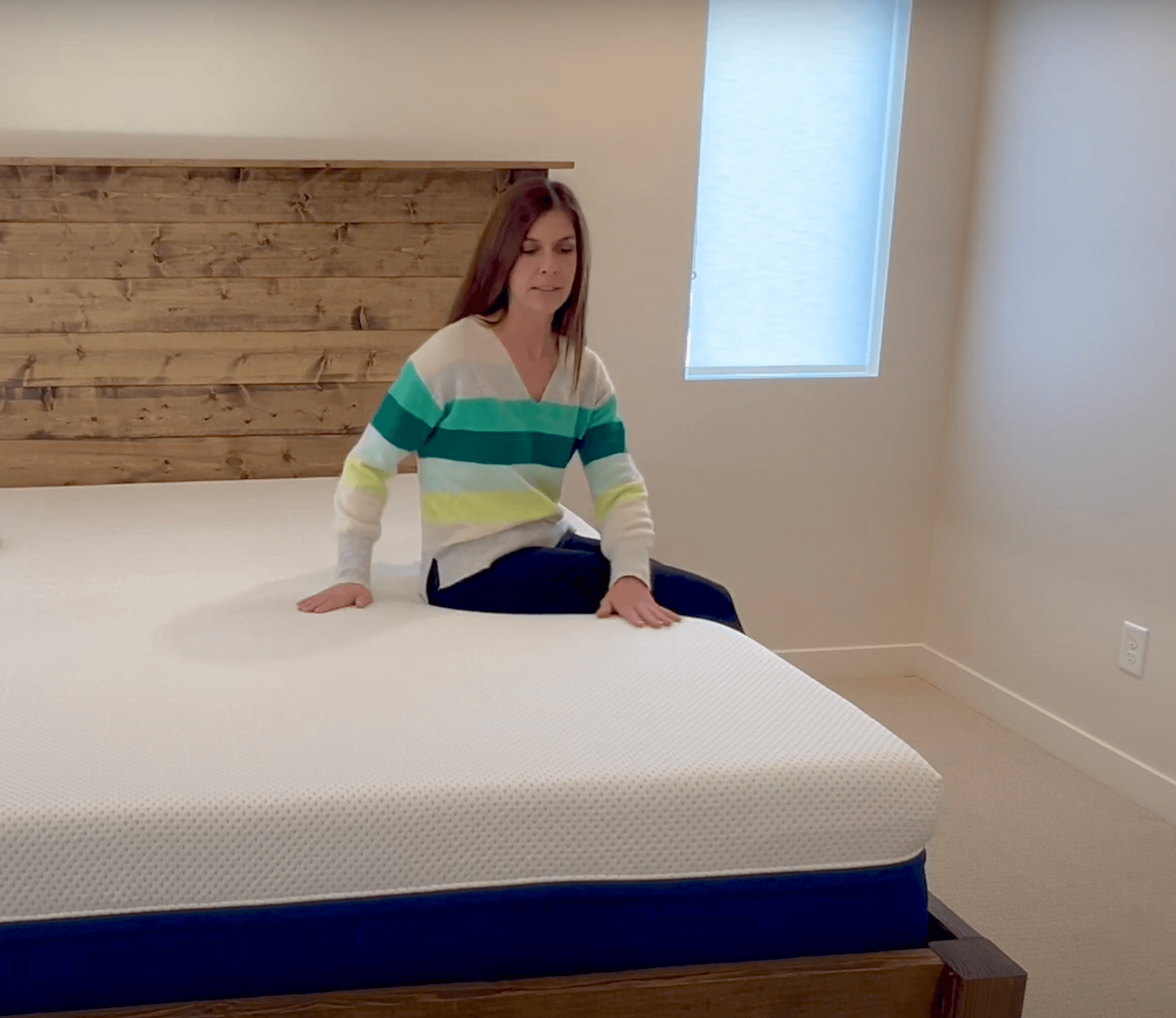


Watch Our Amerisleep AS3 Video Review
The AS3 is the bed I would point most people to first on this list, and the reason is unglamorous: it is easy to move on.
That sounds like a small thing until you are the one doing the moving. A mattress that forms slowly around you and holds the shape has to be climbed out of every time you change position. Over a night, or over weeks of helping someone else shift, that adds up to real effort. The AS3 does the opposite. It contours enough to take the edge off the shoulder and hip, then lets go quickly when you move.
It is a 12-inch all-foam bed at a medium feel, which puts it in the middle of this list on almost every axis. It is not the coolest surface here, not the firmest edge, and not the highest overall score. What it does is combine quick release with the joint-highest motion isolation on the page, at a price below the beds that beat it on individual dimensions.
That combination suits a side or back sleeper who changes position often and shares the bed with someone who moves at night. If you rely on the edge of the mattress to get in and out, look at the Saatva Classic instead.
- 9 Value
- 8 Edge Support
- 9 Trial Period
- 9 Response Time
- 10 Motion Transfer
- 10 Cooling & Breathability
The AS3 was one of the easier beds on this list to move on. When I rolled from my back onto my side, the Bio-Pur foam released almost immediately instead of holding the shape of my last position, so I was not pushing out of a dip to change position. If you are repositioning on a schedule, or helping someone else do it, that difference in effort is what you notice first.
When my partner got out of bed on the far side of a queen, movement on my side barely registered, consistent with its 10/10 motion transfer score. Where someone is checked on overnight, that keeps one person’s movement from costing the other person sleep.
Edge support was the weakest part of its profile. When I sat on the perimeter to put my shoes on, it compressed more than the hybrids I compared in the same session, so anyone leaning on the edge to get in and out of bed should weigh that against the rest.
Best For:
- Sleepers who change position often and want minimal effort doing it
- Anyone sharing a bed with a partner or caregiver who moves at night
- Side and back sleepers who want medium contouring without a deep hug
Compare Instead:
- Saatva Classic if getting in and out of bed at the edge is a daily concern
- FORM Prime if you want a firmer, more responsive surface with the same motion isolation
- Vaya Hybrid if budget is the main constraint
The AS3 does not have the slow-sinking quality of traditional memory foam. When I lay down it responded within a second or two rather than gradually forming around me, which is the single most useful thing about it here.
On my side, my shoulder settled into the surface far enough to take the edge off the contact point without my hip dropping below it. On my back, my hips stayed level with my shoulders and I did not feel a gap under my lower back. On my stomach my hips sat slightly low, which is typical of a true medium.
The cover felt cool on first contact, and through the first hours of testing the surface did not warm as quickly as the denser all-foam beds I compared in the same session.
Changing position is where this bed separates itself. Rolling over took noticeably less effort than on the slower foam beds I tested, because the surface let go rather than holding the previous shape. Someone with limited strength or reach will feel that difference more than a lighter sleeper will.
The AS3 is a 12-inch all-foam build, and the layer that matters most for this guide is the Bio-Pur comfort foam. Its open-cell structure is why the surface released as fast as it did when I changed position, instead of holding a body impression the way slower memory foam does, and that responsiveness is the whole reason it ranked first here.
Underneath, the HIVE transition layer is cut into zones of differing firmness, which is what kept my hips level with my shoulders on my back while still letting my shoulder settle in on my side. The Bio-Core base is dense enough that I did not feel myself reaching the bottom of the mattress in any position, which is what keeps the responsiveness consistent rather than degrading into a dip.
The cover is where the cooling comes from: it felt cool on first contact and the surface did not warm as fast as the denser foam beds I compared. The foams are CertiPUR-US certified and tested for low VOC emissions, and the mattress is fiberglass-free.
Pros
- Motion Transfer (10/10): when my partner got out of bed on the far side of a queen, movement on my side barely registered
- Response Time (9/10): the foam released quickly when I changed position, so rolling from back to side took little effort
- Cooling and Breathability (10/10): the surface felt cool on first contact and did not warm as quickly under sustained contact as the denser foam beds I compared
Cons
- Edge Support (8/10): the perimeter compressed more than the hybrids on this list when I sat on it with full weight
- Available in one firmness, so there is no option to go firmer or softer for a different body weight
Why The Amerisleep AS3 Won
Among the 14 mattresses I kept for this guide, the AS3 was the one that asked the least of me when I changed position. The Bio-Pur foam released almost immediately when I rolled from my back onto my side, and my partner getting out of bed on the far side of a queen barely registered on mine. It does not carry the highest overall score on this page, and its edge support is not the strongest here, but for a sleeper who repositions often and shares a bed, it was the best combination on the list at the price.
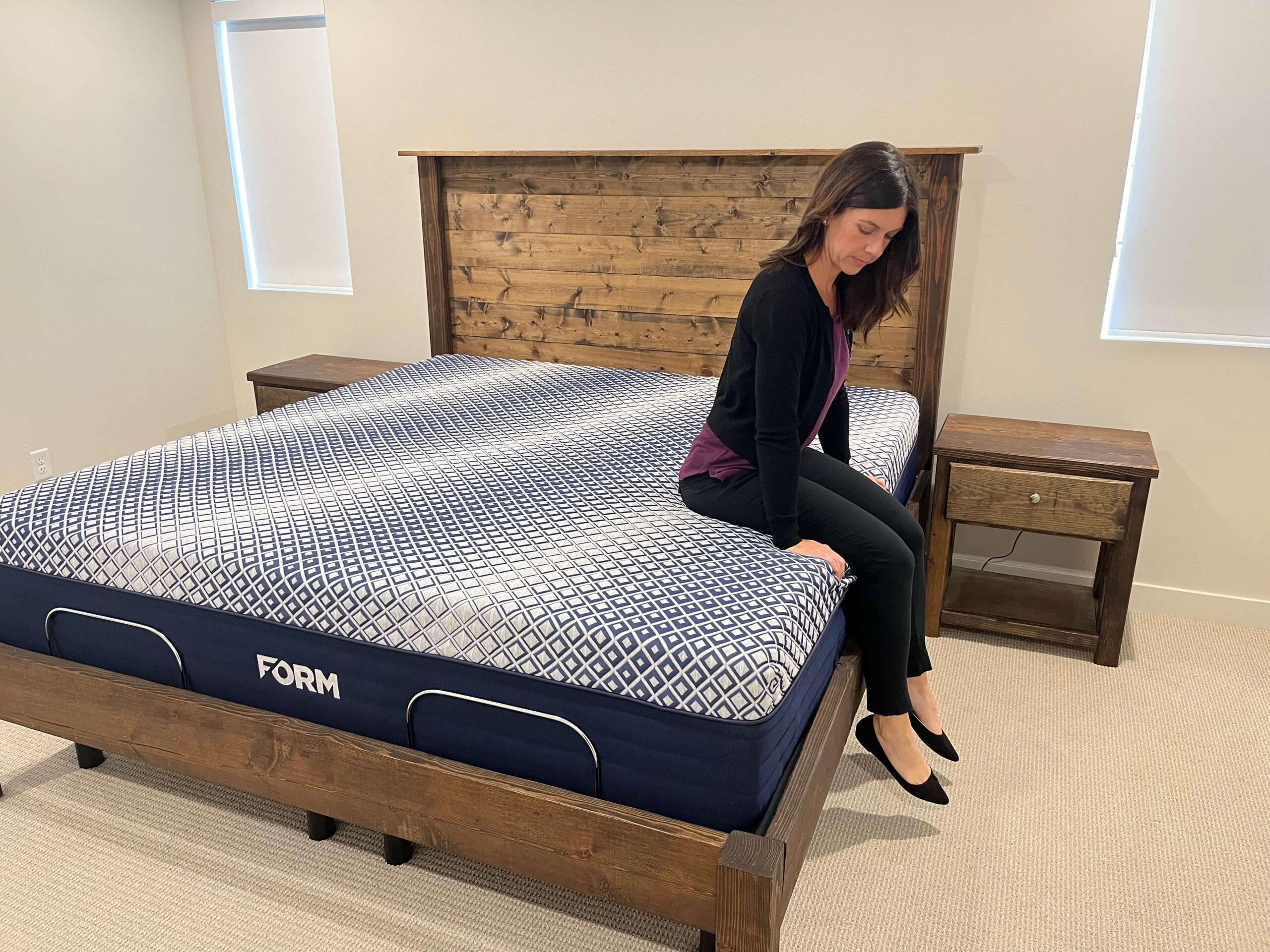
Watch Our FORM Prime Video Review
The FORM Prime is the one bed on this list built around a gel grid rather than foam, latex, or a quilted top. If a grid surface is what brought you to this page, this is the pick.
The grid sits over a seven-zone pocketed coil unit, calibrated softer at the shoulder and firmer through the lumbar. That combination is why it behaves the way it does at the two places this guide cares about most: the perimeter, where it barely moved under my full weight, and the far side of the bed, where a partner getting in and out registered almost nothing.
It is a 14-inch bed in a single firmness, which is the honest limitation. There is no firmer version for someone who wants a non-yielding surface, and the height means deep-pocket sheets and a taller step in and out. It also ships at full size rather than compressed, so there is no expansion wait.
It suits a side or combination sleeper who uses the edge of the bed daily to sit or transfer, and who shares the bed with someone who moves overnight. Stomach sleepers, and anyone who wants a genuinely firm surface, should look elsewhere on this list.
- 8 Value
- 10 Edge Support
- 10 Trial Period
- 9 Response Time
- 10 Motion Transfer
- 9 Cooling & Breathability
The FORM Prime had the steadiest perimeter of anything I tested for this guide. When I sat on the edge with my full weight to put my shoes on, it compressed very little and did not tip me toward the middle, which is why it carries a 10/10 for edge support. If someone is using the side of the bed to get in and out every day, that is the single most useful thing a mattress can do for them.
The grid surface is why. It flexes right where the pressure lands and stays composed everywhere else, so when I pressed a hand down beside me the rest of the surface barely moved. That same property showed up in motion testing: my partner getting in and out on the far side of a queen produced almost nothing on my side.
Underneath, the ZoneCoil 7-Series is calibrated softer at the shoulder and firmer through the lumbar zone. On my side my shoulder settled in while my hip stayed held up, so I did not have to fight a dip when I rolled.
Best For:
- Anyone who relies on the edge of the bed to sit, dress, or get in and out
- Couples where one person moves or gets up during the night
- Side and combination sleepers who want a firmer, more responsive surface than foam
Compare Instead:
- Amerisleep AS3 if you want a softer, more contouring foam feel at a lower price
- Saatva Classic if you want a choice of firmness levels rather than a single feel
- Nolah Evolution if you want a plusher pillow top with the same edge stability
The GelGrid surface flexes quickly and precisely under direct pressure and stays composed everywhere else, closer to a responsive latex feel than to memory foam. There is no slow sink.
On my side, my shoulder dropped into the softer zone while my hip met firmer resistance almost immediately, so my spine stayed level rather than sagging in the middle. On my back the support was even along the lower back with no gap. Stomach sleepers will find the medium zoned feel gives more than they want.
Surface temperature stayed neutral. The cover and the open channels in the grid layer kept air moving, and the surface felt cooler on first contact than the foam beds I compared, though this is a passive design rather than an active one.
Movement stayed contained. Shifting position or getting in and out produced very little disturbance on the opposite side, matching its 10/10 motion transfer score.
The FORM Prime is a 14-inch hybrid, and the layer doing the work for this guide is the BaseFlex foundation. It encases and reinforces the perimeter, and it is why the edge held its shape rather than folding when I sat on it with full weight, which is the behavior that earned this bed its award here.
Above it, the ZoneCoil 7-Series coils are individually wrapped and calibrated into seven zones, softer at the shoulder and firmer through the lumbar. That is what let my shoulder settle in on my side while my hip stayed held up, and it is also why my partner’s movement stayed on their side of the bed: each coil moves independently rather than passing motion along.
The GelGrid and Integra-Mesh comfort layer is the reason the surface flexes exactly where pressure lands and nowhere else, so changing position does not disturb the rest of the bed. The AeroWeave cover and the open channels through the grid kept the surface feeling cooler on contact than the foam beds I compared.
It is CertiPUR-US and GREENGUARD Gold certified, with materials tested to OEKO-TEX Standard 100 for low chemical emissions and restricted substances. It is fiberglass-free and ships at full size, so there is no expansion wait.
Pros
- Edge Support (10/10): the perimeter compressed very little when I sat on it with full weight and did not tip me toward the middle
- Motion Transfer (10/10): my partner getting in and out on the far side of a queen produced almost nothing on my side
- Trial Period (10/10): 365 nights and a lifetime warranty, both well above what most of this list offers
- Ships at full size with no compression, so it is usable the day it arrives
Cons
- Available in one firmness, so there is no option to go firmer for someone who wants a non-yielding surface
- At 14 inches it needs deep-pocket sheets and makes for a higher step in and out of bed
- Value (8/10): priced above the foam and value-tier picks on this page
Sitting on the edge with my full weight was the test this bed passed most clearly: the perimeter barely compressed and did not roll me inward. On my side, the shoulder zone gave while my hip stayed supported, and I could shift position without the surface moving underneath me. It suits a side or combination sleeper who uses the edge of the bed to get in and out daily, and who shares the bed with someone who moves at night.
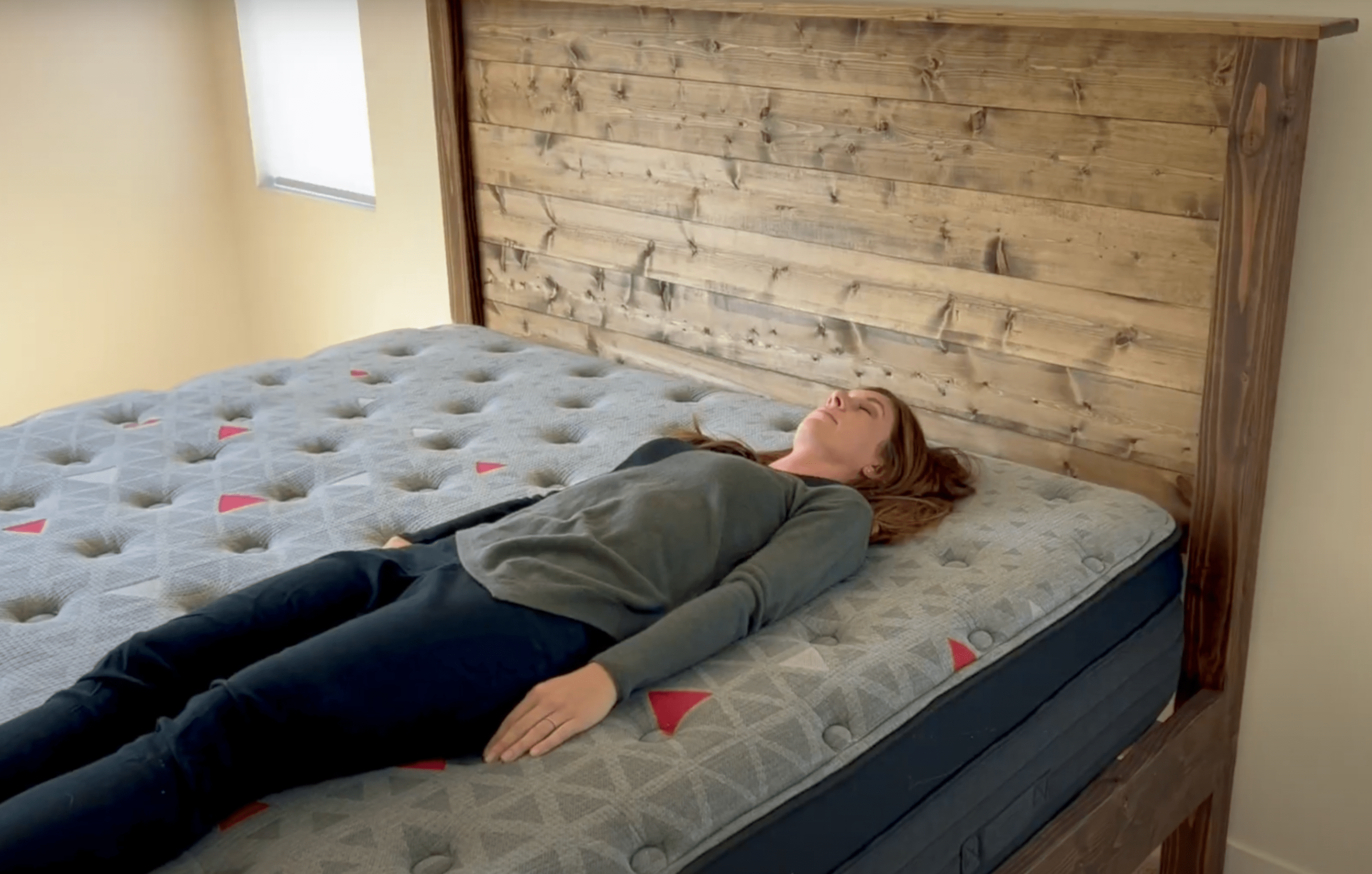
Watch Our Zoma Boost Video Review
The Zoma Boost is the luxury pick here, and what earns it that slot is not the price tag but the combination of a quick-releasing surface with a genuinely stable edge.
Most beds on this list do one or the other well. Deep foam builds contour nicely and then make you work to get out of them. Firm coil builds move easily and give up cushioning at the shoulder. The Boost sits between the two: the Reactiv layer contours on contact and then pushes back up under you when you shift, so changing position does not mean climbing out of a depression.
At 15 inches it is the tallest bed on this page. That is worth planning around. It means deep-pocket sheets, a higher step in and out, and enough weight that rotating it is a two-person job. If the bed frame is already tall, this one may put the sleeping surface higher than is comfortable.
It suits a side or combination sleeper who repositions often, wants a firmer surface to push off, and has the frame height to take it. If the step in and out matters more than the feel, the AS3 sits three inches lower.
- 10 Value
- 10 Edge Support
- 9 Trial Period
- 9 Response Time
- 10 Motion Transfer
- 9 Cooling & Breathability
The Zoma Boost pairs a quick-releasing surface with the steadiest perimeter in the upper half of this list. When I sat on the edge to put my shoes on, it held its shape rather than compressing under me, and it carries a 10/10 for edge support because of it.
The Reactiv foam layer is what makes repositioning easy here. When I rolled from my back to my side, the surface came back up under me rather than staying in the shape I had just left, so I was not climbing out of a depression to move. That combination of contouring on contact and quick rebound is unusual in a bed this tall.
Motion stayed contained. When my partner shifted on the far side of a queen, I felt almost nothing on my side, which matches its 10/10 motion transfer score.
The tradeoff is the height. At 15 inches this is the tallest bed on the page, which makes the step in and out higher than most.
Best For:
- Sleepers who change position often and want a firmer surface to push off
- Anyone who sits on the edge of the bed to dress or transfer
- Couples where one person moves or gets up overnight
Compare Instead:
- Amerisleep AS3 if you want a lower-profile bed with an easier step in and out
- Vaya Hybrid if you want similar responsiveness at a much lower price
- Saatva Classic if you want a choice of firmness levels
The Boost reads medium-firm rather than medium. There is contouring at the shoulder and hip, but the surface stops well short of the deep sink some memory foam beds have.
On my side, my shoulder settled in without my hip dropping through. On my back my hips stayed level with my shoulders and the lower back stayed in contact with the surface. Stomach sleepers will find it supportive enough to keep hips from sagging.
The cover felt cool on first contact, and through the first hours the surface did not warm as quickly as the denser all-foam beds I compared in the same session.
Moving on it is easy. The coils and the Reactiv layer give the surface a push back, so rolling over or sitting up takes less effort than on an all-foam bed of similar depth. The 15-inch height is noticeable getting in and out, and the reinforced edge held steady when I sat on it.
The Zoma Boost is a 15-inch hybrid, and the layer that decided its ranking here is the Reactiv foam in the middle of the stack. It is what brought the surface back up under me when I changed position instead of leaving me in the shape I had just left, which is the difference between easy repositioning and effortful repositioning.
The graphite-infused Energex memory foam above it does the contouring at the shoulder and hip, but it recovers faster than conventional memory foam, so the contouring never turns into a dip you have to climb out of. The quilted gel foam layer above that is what the surface feels like on first contact, and it stayed cooler for longer under sustained contact than the denser foam beds I compared.
Underneath, the pocketed coils are zoned with reinforcement around the perimeter, which is why the edge held its shape when I sat on it with full weight rather than folding. Each coil moves independently, and that is what kept my partner’s movement from carrying across the bed. A durable base foam stabilizes the stack so the responsiveness stays consistent rather than settling into a soft spot.
The foams are CertiPUR-US certified and tested for low VOC emissions, made in the USA, and fiberglass-free.
Pros
- Edge Support (10/10): the perimeter held its shape when I sat on it with full weight rather than compressing under me
- Motion Transfer (10/10): when my partner shifted on the far side of a queen I felt almost nothing on my side
- Value (10/10): the strongest score-to-price ratio in the upper half of this list
- Response Time (9/10): the Reactiv layer brought the surface back up under me when I changed position
Cons
- At 15 inches this is the tallest bed on the page, so the step in and out is higher than most and it needs deep-pocket sheets
- Heavier than the all-foam picks here, which makes rotating it a two-person job
- Available in one firmness, so there is no softer or firmer option for a different body weight
Rolling from my back onto my side on the Boost took less effort than the depth of the bed suggested, because the Reactiv layer pushed the surface back up under me rather than holding the shape I had left. Sitting on the edge to put my shoes on, the perimeter stayed steady. It suits a side or combination sleeper who repositions often, wants a firmer surface to push off, and has the frame height to take a 15-inch mattress.

Watch Our Vaya Hybrid Video Review
The Vaya Hybrid is the budget pick, and it is on this list because of one score: a 10 out of 10 for response time, tied for the fastest surface on the page.
That matters more here than it would on a general comfort roundup. The whole premise of this guide is that changing position should be easy, and the Vaya’s comfort foam is back up under you before you have finished settling. It pairs that with a perimeter that barely gave when I sat on it, which is unusual at this price and useful for anyone using the side of the bed to get in and out.
Where it gives ground is motion transfer, and it gives ground clearly. At 7 out of 10 it is the lowest on this page. If someone is being checked on or repositioned overnight, movement will carry across the bed in a way it does not on the higher-scoring picks.
That makes it a good fit for a back or combination sleeper on a budget who repositions frequently and either sleeps alone or shares with a partner who stays still. If two people are in the bed and one of them gets up, spend the extra on the AS3 or the Zoma Boost.
- 10 Value
- 10 Edge Support
- 9 Trial Period
- 10 Response Time
- 7 Motion Transfer
- 9 Cooling & Breathability
The Vaya Hybrid had the fastest surface rebound of anything I tested for this guide. When I rolled from my back to my side, the comfort foam was already back up under me by the time I settled, with none of the lag the denser memory foam beds here have. It carries a 10/10 for response time and it earned it.
The perimeter matched it. When I sat on the edge with my full weight it barely gave, which is unusual at this price and matters for anyone using the side of the bed to get in and out.
The honest limitation is motion transfer. At 7/10 it is the lowest on this page. When my partner got in on the far side of a queen, I felt it on my side in a way I did not on the AS3 or the FORM Prime. If someone is being checked on overnight, that is a real consideration.
Best For:
- Sleepers who reposition often and want the least effort doing it
- Anyone who needs a steady edge for getting in and out of bed
- Buyers on a tight budget who do not want to give up responsiveness
Compare Instead:
- Amerisleep AS3 if a partner or caregiver moves during the night
- Zoma Boost if you want the same responsiveness with far better motion isolation
- FORM Prime if the edge is the priority and budget allows
The Vaya sits at the firmer end of medium. There is enough give at the shoulder and hip to take the edge off the contact point, but you rest on the surface rather than in it.
On my back my hips stayed level with my shoulders with no gap under the lower back. On my side my shoulder settled in but not deeply, so strict side sleepers who want a plush contour will find it firm. Stomach sleepers get enough support to keep hips from dropping.
The surface felt cool on first contact and the coil layer kept air moving, so it did not warm as quickly under sustained contact as the all-foam beds I compared.
Moving is the easiest thing about this bed. The coils give it a push back and the foam recovers immediately, so rolling over takes very little effort. The edge stayed firm when I sat on it. Where it falls short is isolation: my partner getting in was noticeable in a way it was not on the higher-scoring beds here.
The Vaya Hybrid is a 14-inch build, and the layer that earned its ranking is the proprietary Vaya Comfort Foam. Its open, porous structure is why the surface came back up under me immediately when I changed position rather than lagging the way denser memory foam does, and that rebound speed is the reason this bed carries a 10/10 for response time.
Beneath it, the pocketed coils supply the push back that makes rolling over easy, and the reinforced perimeter is why the edge stayed firm when I sat on it with full weight. Those same coils are also where the bed gives ground: they transmit more movement across the surface than the fully wrapped systems in the higher-scoring hybrids here, which is what its 7/10 motion transfer reflects.
The quilted cotton beneath the cover is what the surface feels like on first contact, and together with the airflow through the coil layer it kept the bed from warming as fast as the all-foam models I compared. A base foam stabilizes the coil unit so the responsiveness holds up rather than settling unevenly.
The foams are CertiPUR-US certified and tested for low VOC emissions.
Pros
- Response Time (10/10): the comfort foam was back up under me by the time I settled after changing position, the fastest rebound on this page
- Edge Support (10/10): the perimeter barely gave when I sat on it with full weight
- Value (10/10): the strongest price-to-performance on the list
Cons
- Motion Transfer (7/10): the lowest on this page. My partner getting in on the far side of a queen was noticeable on my side
- Available in one medium feel, which is firmer than strict side sleepers usually want at the shoulder
- Needs about a week of break-in before it settles to its final feel
Changing position on the Vaya took less effort than on any other bed I tested for this guide, because the comfort foam recovered immediately rather than holding the shape I had left. Sitting on the edge, the perimeter stayed firm under full weight. It suits a back or combination sleeper on a budget who repositions frequently and sleeps alone or with a partner who stays still, since motion transfer is where this bed gives ground.
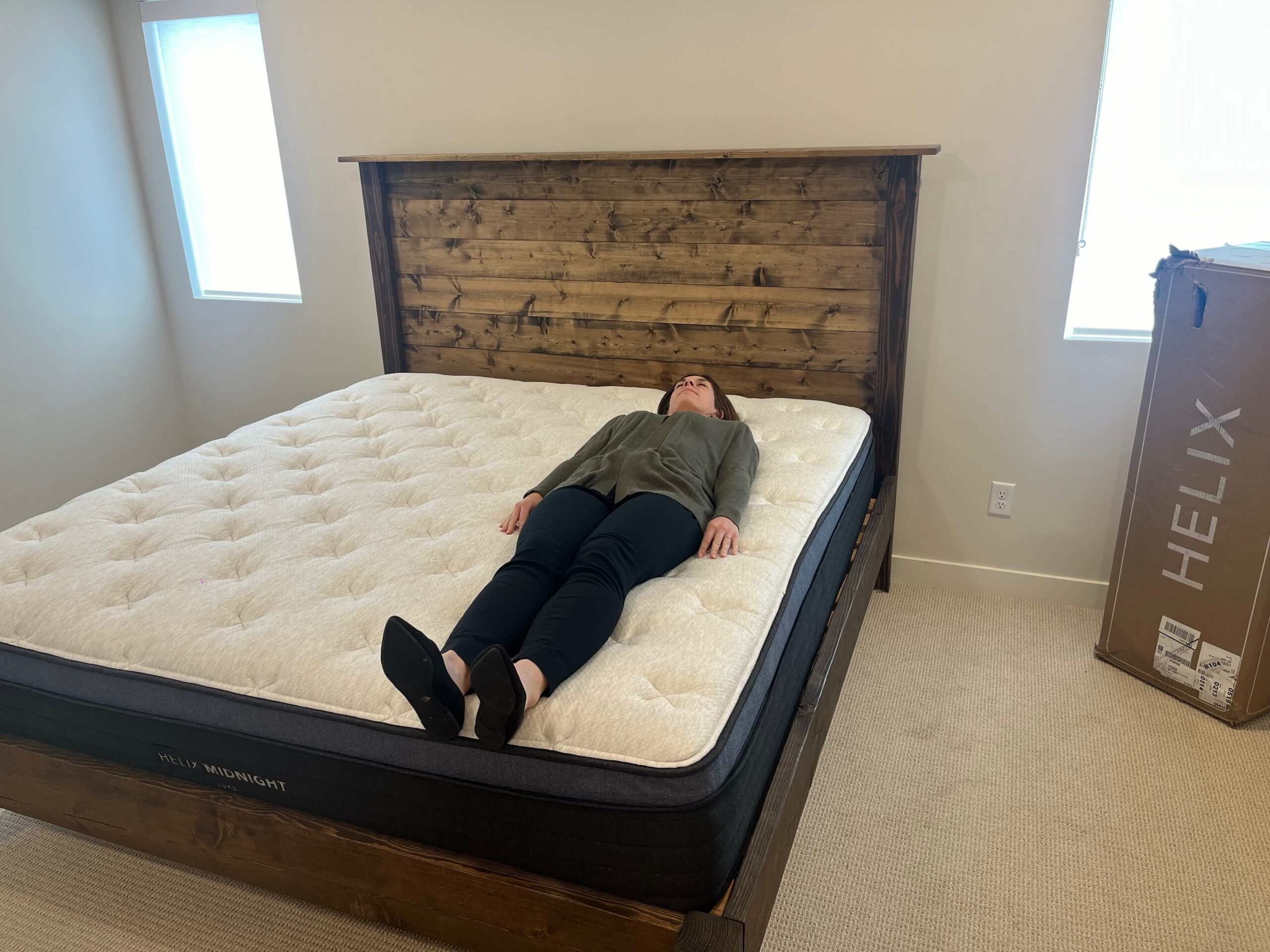
Watch Our Helix Midnight Luxe Video Review
Side sleeping puts most of your weight through two contact points, the shoulder and the hip. A surface that is too firm pushes back at the shoulder; one that is too soft lets the hip drop and bends the spine. The Midnight Luxe is on this list because it handles both at once better than anything else here.
It does that with a zoned coil unit rather than a zoned foam layer, which is the meaningful difference. The coils under the shoulder are calibrated softer and the coils under the hip firmer, so the give happens where you want it and stops where you do not. On my side the effect was more pronounced than on any other bed I tested for this guide.
It ships in a single medium feel. The cover and layer upgrades change temperature and lumbar support, not firmness, so there is no softer or firmer version to choose. At 7 out of 10 for value it also carries the weakest score-to-price ratio on this page, and the cooling cover is a paid add-on on top of that.
It suits a side sleeper who shares the bed with someone who moves overnight and uses the edge to get in and out, provided the price works. Back and stomach sleepers who want a firmer surface should look at the Saatva Classic, which offers three firmness levels.
- 7 Value
- 10 Edge Support
- 9 Trial Period
- 9 Response Time
- 10 Motion Transfer
- 9 Cooling & Breathability
The Midnight Luxe was the most forgiving bed here for side sleeping. When I lay on my side, my shoulder dropped into the softer coil zone far enough that I did not feel it being pushed back on, while my hip met firmer resistance and stayed up. That differential is the whole point of a zoned coil unit and it is more noticeable on this bed than on anything else I tested for this guide.
The perimeter was equally strong. Sitting on the edge with my full weight to put my shoes on, it stayed flat and stable rather than compressing under me, which is why it carries a 10/10 for edge support.
Motion stayed put. My partner shifting on the far side of a queen barely registered on mine, consistent with its 10/10 motion transfer score.
The limitation is price. At 7/10 for value this is the weakest score-to-price ratio on the page, and the cooling cover upgrade adds to it.
Best For:
- Side sleepers who want the shoulder to settle in without the hip dropping
- Anyone who uses the edge of the bed to sit or transfer
- Couples where one person moves or gets up overnight
Compare Instead:
- Amerisleep AS3 if you want a similar medium feel at a much lower price
- Nolah Evolution if you want a choice of firmness levels
- Amerisleep AS5 Hybrid if you want a genuinely soft surface rather than a zoned medium
The quilted pillow top gives immediately on contact, then the zoned coils take over. On my side my shoulder sank in far enough to relieve the contact point without my spine bending, and my hip stayed held up rather than dropping through.
On my back the support was even along the lower back with no gap. Stomach sleepers will find the medium feel gives more at the hip than they want, since this bed ships in a single medium and there is no firmer version of it.
The standard cover felt neutral to slightly cool on first contact. The upgraded cooling cover felt distinctly cooler when I first lay down, and the surface warmed more slowly under sustained contact than the standard version did.
Changing position took moderate effort. The pillow top has more give than the grid and latex surfaces here, so rolling over is a little slower than on the FORM Prime, though the coils underneath still push back rather than letting you settle in.
Sitting on the edge, the perimeter stayed flat and stable under full weight.
The Midnight Luxe is a 13.5-inch hybrid, and the layer that decides how it performs here is the zoned coil unit. The coils are calibrated softer under the shoulder and firmer under the hip, and that is precisely what I felt on my side: the shoulder settled in while the hip stayed up. It is also why my partner’s movement did not carry across, since each coil is individually wrapped and compresses only where the weight lands.
The perimeter coils are reinforced, and that is what kept the edge flat and stable when I sat on it with full weight rather than folding under me.
Above the coils, the copper gel memory foam is the layer doing the contouring at the shoulder and hip, and it recovers quickly enough that rolling over did not mean climbing out of a body impression. The quilted pillow top is what the surface feels like on first contact. The standard cover reads neutral to slightly cool; the upgraded cooling cover felt distinctly cooler when I first lay down and warmed more slowly under sustained contact.
A dense base foam stabilizes the coil unit underneath so the zoning stays consistent rather than settling unevenly. The foams are CertiPUR-US certified and the mattress is GREENGUARD Gold certified for low chemical emissions.
Pros
- Edge Support (10/10): the perimeter stayed flat and stable when I sat on it with full weight
- Motion Transfer (10/10): my partner shifting on the far side of a queen barely registered on my side
- Zoned coils: on my side my shoulder settled into the softer zone while my hip stayed held up, the clearest zoning effect of anything I tested here
Cons
- Value (7/10): the weakest score-to-price ratio on this page, and the cooling cover is a paid upgrade on top
- Available in one medium feel, so there is no firmer or softer version for a different body weight
- The pillow top has more give than the firmer surfaces here, so rolling over takes a little more effort
Lying on my side, the shoulder zone gave far enough that I did not feel pushed back on while my hip stayed held up, which is the clearest zoning effect of anything I tested for this guide. The perimeter stayed flat when I sat on it with full weight. It suits a side sleeper who shares the bed with someone who moves at night and who uses the edge to get in and out, provided the price fits.

Watch Our Saatva Classic Video Review
The Saatva Classic is the only bed on this page that scored 10 out of 10 on all three of the dimensions this guide weights most heavily: response time, edge support, and trial period.
Coil beds get overlooked in conversations about cushioning, but for this particular problem they have a structural advantage. A coil unit returns the instant weight lifts off it. There is no depression to push out of, which is exactly what makes changing position take less effort. The dual-coil build here adds a layer of smaller comfort coils above the support unit, so the surface cushions on contact rather than feeling like you are lying on springs.
Two practical points matter more on this page than they would elsewhere. It comes in three firmness levels, which is useful when the person buying the bed and the person sleeping on it are not the same person. And it arrives fully expanded with in-home setup instead of compressed in a box, so there is no waiting for it to become usable.
It suits a sleeper who repositions frequently, uses the side of the bed to get in and out, and wants to pick a firmness rather than accept a single feel. The tradeoffs are price and weight: it is among the most expensive picks here and it cannot be moved without help.
- 7 Value
- 10 Edge Support
- 10 Trial Period
- 10 Response Time
- 9 Motion Transfer
- 9 Cooling & Breathability
The Saatva Classic scored 10/10 on all three of the dimensions that decided this guide, and it is the only bed on the page that did. When I rolled from my back to my side the coil unit pushed back immediately rather than letting me settle into a depression, so repositioning took almost no effort. When I sat on the edge with full weight, the perimeter stayed firm and level. And it ships with a 365-night trial, the longest on this list alongside the FORM Prime and the Sparrow.
There is one more thing that matters for this guide specifically and is easy to overlook: it arrives fully expanded with in-home setup rather than compressed in a box. If the bed is needed right away, that removes the expansion wait entirely.
It also comes in three firmness levels, which is genuinely useful when the person sleeping on it and the person buying it are not the same person.
Best For:
- Sleepers who reposition often and want the least resistance doing it
- Anyone who needs a steady edge for getting in and out of bed
- Buyers who want to pick a firmness rather than accept a single feel
Compare Instead:
- Amerisleep AS3 if you want a contouring foam feel rather than a coil surface
- FORM Prime if motion isolation matters more than firmness choice
- Vaya Hybrid if the budget will not stretch to a luxury innerspring
The Euro pillow top gives on contact, then the two coil layers take over and push back. You rest on this bed rather than in it, which is the defining difference from the foam picks here.
Firmness choice changes the experience substantially. Plush Soft lets the shoulder and hip settle in noticeably deeper, Luxury Firm sits balanced across positions, and Firm keeps you highest on the surface. On the Luxury Firm my hips stayed level with my shoulders on my back and my shoulder settled in adequately on my side.
The organic cotton cover felt cool on first contact, and airflow through the open coil structure kept the surface from warming as quickly as the all-foam beds I compared under sustained contact.
Changing position took the least effort of anything I tested. The coils return immediately, so rolling over does not mean pushing out of a depression. The perimeter stayed firm and level when I sat on it with full weight.
One characteristic worth naming: this bed has real bounce. If you are used to memory foam it will feel lively rather than enveloping.
The Saatva Classic is a dual-coil build, and the coil-on-coil structure is the reason it took the top response-time score here. The main support unit returns immediately when weight lifts off it, so rolling from back to side never involved pushing out of a depression the way it does on the deeper foam beds on this page.
The upper comfort coil layer is what keeps that responsiveness from feeling harsh. Smaller and more compliant than the support coils, it lets the shoulder and hip settle in on contact before the main unit engages, which is why the bed feels cushioned without ever feeling slow.
Around the perimeter, high-density foam edge reinforcement is what kept the edge firm and level when I sat on it with full weight, and the Lumbar Zone reinforcement through the center third is why my hips stayed in line with my shoulders on my back rather than dipping.
The 3-inch Euro pillow top is what the surface feels like on first contact, and the organic cotton cover with airflow through the open coil structure is why it did not warm as quickly as the all-foam beds I compared. The cover carries a botanical antimicrobial treatment, and a natural thistle pulp barrier provides fire resistance in place of fiberglass. The foams are CertiPUR-US certified and tested for low VOC emissions.
Pros
- Response Time (10/10): the coil unit returned immediately when I changed position, the least effortful repositioning of anything I tested here
- Edge Support (10/10): the perimeter stayed firm and level when I sat on it with full weight
- Trial Period (10/10): 365 nights with a lifetime warranty
- Arrives fully expanded with in-home setup, so there is no compression or expansion wait
Cons
- Value (7/10): among the most expensive picks on this page
- Heavy enough that rotating it is a two-person job
- The coil surface has real bounce, which will feel unfamiliar coming from memory foam
Rolling from my back onto my side on the Saatva took less effort than on any other bed I tested for this guide, because the coil unit returned immediately instead of holding a depression. Sitting on the edge, the perimeter stayed firm and level under full weight. It suits a sleeper who repositions frequently, uses the side of the bed to get in and out, and wants to choose a firmness rather than accept a single feel.
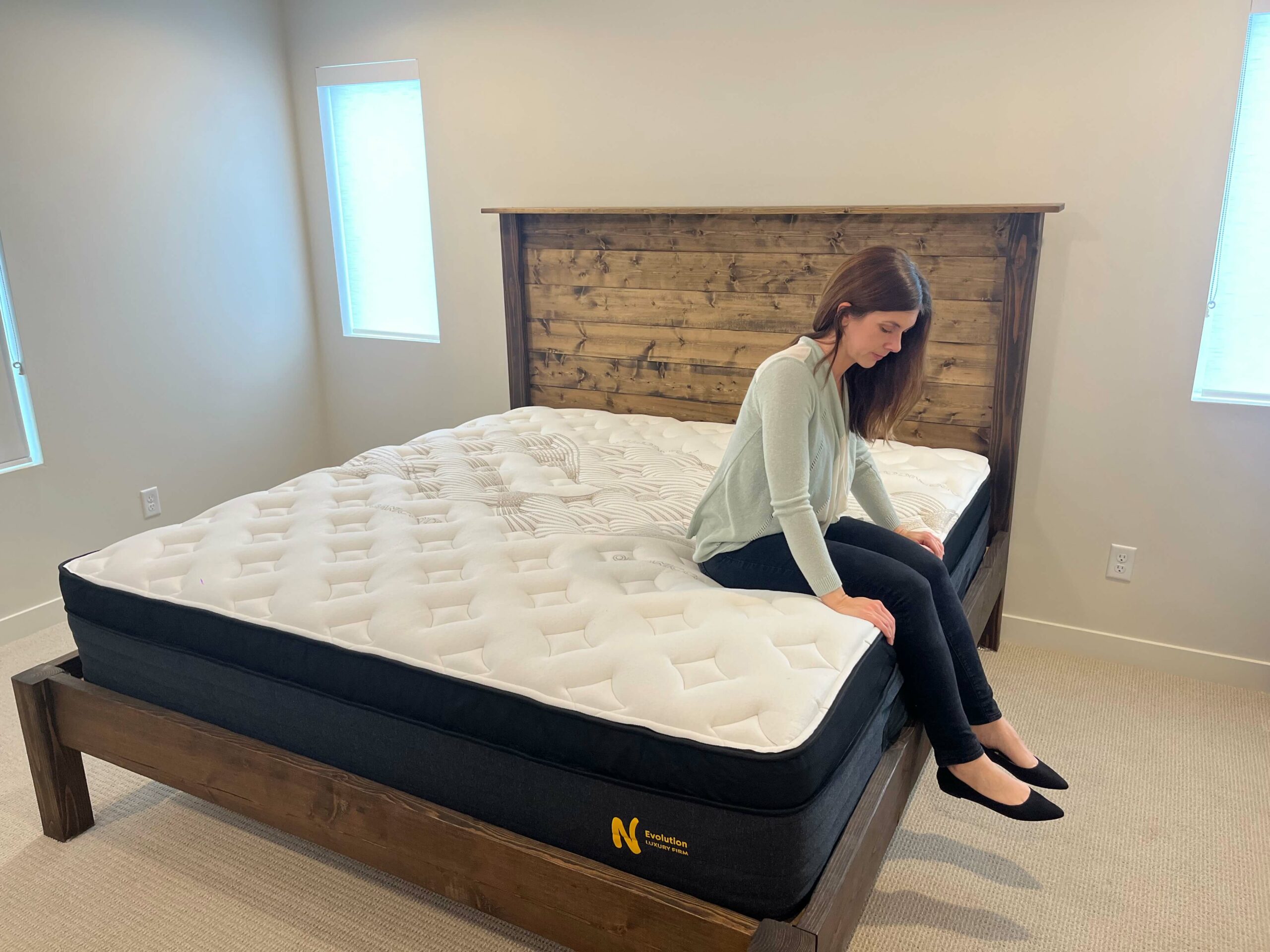
Watch Our Nolah Evolution Video Review
Pillow tops usually come with a hidden cost at the edge. Pile enough soft quilting on top of a mattress and the perimeter is the first thing to collapse under you. The Nolah Evolution is on this list because it does not.
The coils around its border are pencil-reinforced, and when I sat on the edge with my full weight it held flat rather than folding. That is the least expected thing about this bed and the main reason it ranks where it does here. It pairs that with the highest overall score on the page and a 10 out of 10 for motion transfer.
Three firmness levels are available, which matters when the bed is being chosen for someone else. The quilted top does release a beat slower than the coil-heavy picks here, so repositioning takes slightly more effort than on the Saatva or the Vaya, though never enough to feel like climbing out of a dip.
It suits a side or combination sleeper who wants pillow-top cushioning without losing a usable edge, and who shares the bed with someone who moves at night. If repositioning speed is the single priority, the Saatva Classic is the faster surface.
- 10 Value
- 10 Edge Support
- 9 Trial Period
- 9 Response Time
- 10 Motion Transfer
- 9 Cooling & Breathability
The Evolution is the highest-scoring bed on this page at 9.5, and it holds a 10/10 for both edge support and motion transfer. When I sat on the perimeter to put my shoes on, the pencil-reinforced coils held it flat rather than letting it collapse, which is unusual for a pillow top and is the main reason it ranks where it does here.
Repositioning was easier than the depth of the pillow top suggests. When I rolled from my back onto my side the surface released within a beat rather than holding the shape, because the coil unit underneath is doing more of the work than the quilted top implies.
My partner moving on the far side of a queen produced almost nothing on my side, matching its 10/10 motion transfer score.
It also comes in three firmness levels, which matters when the bed is being chosen for someone other than the buyer.
Best For:
- Anyone who wants pillow-top cushioning without giving up a stable edge
- Sleepers who share the bed with someone who moves or gets up overnight
- Buyers who want to pick a firmness rather than accept a single feel
Compare Instead:
- Saatva Classic if repositioning speed is the single highest priority
- Amerisleep AS3 if you want a lower-profile bed with an easier step in and out
- Vaya Hybrid if budget is the main constraint
The quilted pillow top compresses gently on contact, then the foam layers and the coil unit take over. There is no sudden transition from soft surface to firm core.
Firmness choice changes it substantially. Plush lets the shoulder and hip settle in deeply, Luxury Firm sits balanced across positions, and Firm keeps you highest on the surface. On the Luxury Firm my shoulder settled into the softer perforated zone on my side while my hip met firmer resistance, and my hips stayed level with my shoulders on my back.
The standard cotton cover felt neutral on first contact; the upgraded cooling pillow top felt distinctly cooler when I first lay down and warmed more slowly under sustained contact.
Changing position took modest effort. The surface releases within a beat rather than immediately, so it is a step slower than the coil-heavy picks here, though never slow enough to feel like climbing out of a dip.
The perimeter held flat when I sat on it with full weight.
The Evolution is a hybrid built on a zoned coil unit, and the perimeter treatment is what earned its award here. The coils around the edge are pencil-reinforced, and that is why the edge stayed flat when I sat on it with full weight rather than collapsing the way most pillow-top perimeters do.
Above the coils, the perforated AirFoam Luxe is the layer that handles the shoulder. It is hole-punched in the shoulder zone, which is what let my shoulder settle in on my side while my hip met firmer resistance and stayed up. Below it, the Tri-Zone foam is firmest through the center third, and that is why my hips stayed level with my shoulders on my back instead of dipping.
The quilted top is what the surface feels like on first contact. With the standard cotton cover it reads neutral; the upgraded cooling version felt distinctly cooler when I first lay down and warmed more slowly under sustained contact. The border gusset lets heat move out through the sides rather than only through the surface, which is part of why the bed did not warm as fast as the all-foam picks I compared.
The transition foam between the comfort layers and the coils is what absorbs the spring action, and together with the individually wrapped coils it is why my partner’s movement stayed on their side. The foams are CertiPUR-US and GREENGUARD Gold certified. The mattress is fiberglass-free.
Pros
- Edge Support (10/10): the pencil-reinforced perimeter held flat when I sat on it with full weight, unusual for a pillow top
- Motion Transfer (10/10): my partner moving on the far side of a queen produced almost nothing on my side
- Value (10/10): the highest overall score on this page at a price below the luxury picks
- Three firmness levels, so the feel can be matched to body weight rather than accepted as-is
Cons
- The pillow top releases a beat slower than the coil-heavy picks here, so repositioning takes slightly more effort
- At 14 inches or more it needs deep-pocket sheets and makes for a higher step in and out of bed
- The cooling pillow top and white-glove setup are both paid upgrades rather than included
- Heavy enough that rotating it is a two-person job
Sitting on the edge with my full weight, the perimeter held flat rather than collapsing, which is the last thing I expected from a pillow top this deep. On my side the perforated shoulder zone let my shoulder settle while my hip stayed up. It suits a side or combination sleeper who wants pillow-top cushioning without losing a usable edge, and who shares the bed with someone who moves at night.
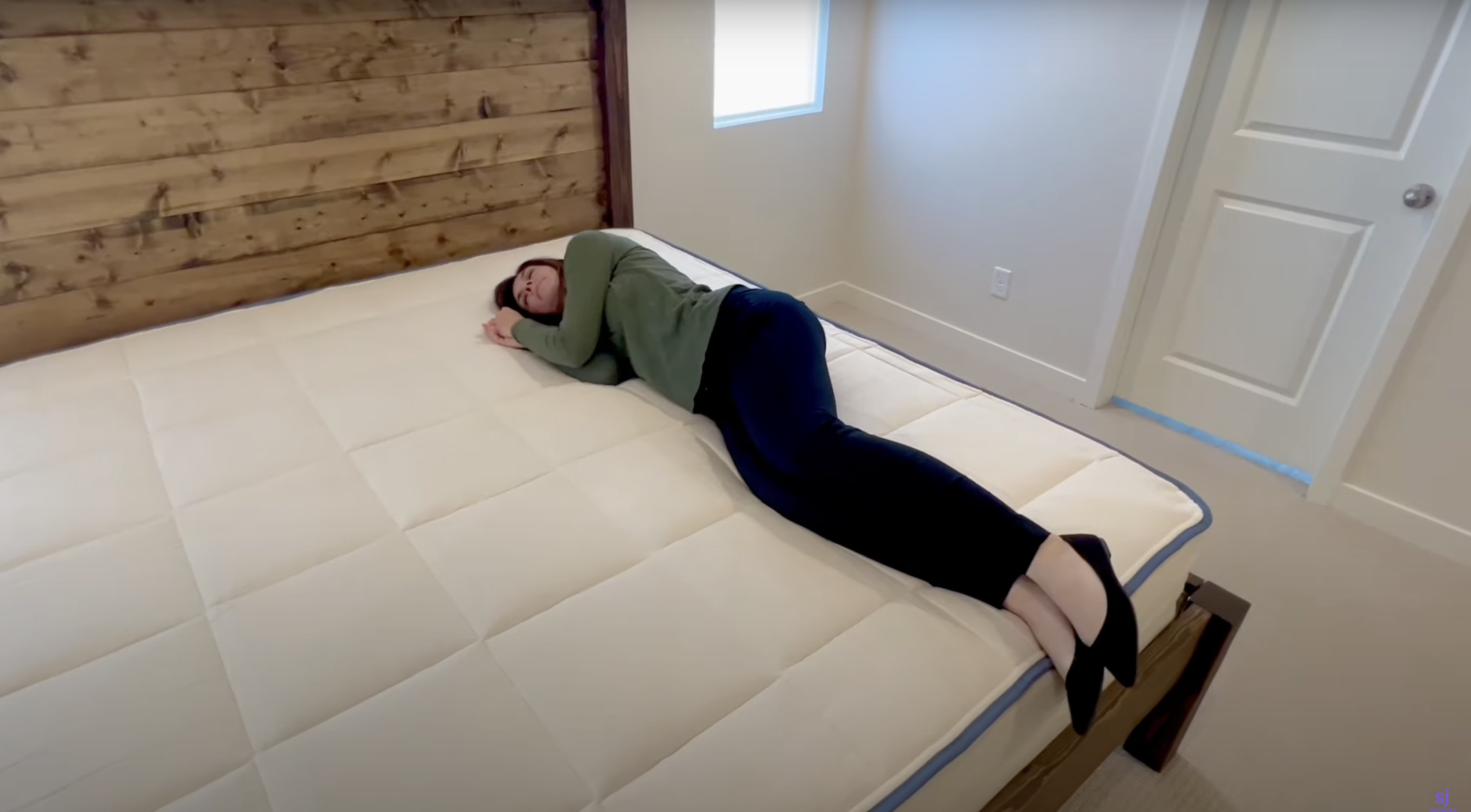
Watch Our Amerisleep Organica Mattress Video Review
The Organica is the pick for anyone who wants to avoid memory foam entirely, and latex turns out to suit this guide’s priorities better than its reputation suggests.
Latex does not form around you and hold the shape. It yields, holds you up, and returns the instant weight comes off it. That makes it one of the three fastest surfaces on this page for changing position, tied with the Saatva and the Vaya at 10 out of 10 for response time. If rolling over with minimal effort is the goal and memory foam is off the table, this is the bed.
The organic wool layer under the cover is doing more than padding. It absorbs moisture off the surface rather than letting it sit, which is why the bed felt dry rather than clammy after extended contact, and it serves as the fire barrier in place of chemical retardants.
The limitation is the edge. At 8 out of 10 it is tied for the weakest perimeter among the top picks, and it compressed more under my full weight than the coil-heavy hybrids here. It suits a back or combination sleeper who repositions often and wants a latex surface, provided they are not relying on the side of the bed to get in and out.
- 9 Value
- 8 Edge Support
- 9 Trial Period
- 10 Response Time
- 9 Motion Transfer
- 9 Cooling & Breathability
The Organica had the quickest surface rebound of the latex builds I tested and ties the Saatva and the Vaya at 10/10 for response time. Latex pushes back rather than forming around you, so when I rolled from my back to my side there was nothing to climb out of. If effortless repositioning is the priority and you want to avoid memory foam, this is the pick.
The wool layer under the cover is doing more than padding. It absorbs moisture off the surface rather than letting it sit, which is why the bed felt dry rather than clammy after extended contact even though latex itself is not a cooling material.
The honest limitation is the edge. At 8/10 it is tied for the weakest perimeter among the top picks here. When I sat on it with full weight it compressed more than the coil-heavy hybrids on this page.
Best For:
- Sleepers who want the least resistance when changing position
- Anyone looking to avoid memory foam entirely
- Back and combination sleepers who want a buoyant rather than contouring surface
Compare Instead:
- FORM Prime if you want the same responsive feel with a much stronger edge
- Saatva Classic if you want a choice of firmness levels
- PlushBeds Signature Bliss if organic certification is the priority
Latex behaves differently from both memory foam and innerspring. The surface yields smoothly to your shape and then stops, holding you up rather than letting you settle further in.
On my side my shoulder settled in adequately without my hip dropping through. On my back my hips stayed level with my shoulders. The medium suits back and combination sleepers best; strict side sleepers who want a deep shoulder contour will find it firm and should look at the taller Plush Box-Top instead.
The wool layer under the cover kept the surface feeling dry rather than clammy after extended contact, and the bed did not warm as quickly as the memory foam models I compared in the same session.
Changing position took almost no effort. Latex returns instantly, so rolling over never involved pushing out of a depression.
Sitting on the edge, the perimeter compressed more than the coil-heavy hybrids here before it steadied.
New latex has a faint earthy smell that fades within a few days.
The Organica is a latex hybrid, and the Talalay latex comfort layers are the reason it ties for the top response-time score on this page. Latex returns to shape the instant weight lifts off it, so rolling from back to side never involved pushing out of a depression the way it does on memory foam. That is the single property that put this bed on the list.
The two latex layers are stacked soft over medium, which is what let my shoulder settle in on my side while the layer beneath kept my hip from dropping through.
The organic wool above them is doing the moisture work. It absorbs moisture off the surface rather than letting it sit, which is why the bed felt dry rather than clammy after extended contact, and it also serves as the fire barrier in place of chemical retardants or fiberglass.
Underneath, the pocketed coil unit is what keeps a latex bed from feeling like a solid slab, and its reinforced edge coils are what eventually steady the perimeter, though it still compressed more under full weight than the coil-heavy hybrids here. The organic cotton cover is what the surface feels like on first contact and lets air move through rather than trapping it.
The latex carries OEKO-TEX Standard 100 certification, tested for restricted substances, along with Rainforest Alliance and eco-INSTITUT certification. The wool is OEKO-TEX certified.
Pros
- Response Time (10/10): latex returned to shape instantly, so changing position never meant pushing out of a depression
- The wool layer kept the surface feeling dry rather than clammy after extended contact
- No memory foam anywhere in the build, for anyone who wants to avoid it
- Two height and feel options, so the surface can be matched to body weight
Cons
- Edge Support (8/10): the perimeter compressed more than the coil-heavy hybrids here when I sat on it with full weight
- Heavier than the foam picks on this page, so rotating it is a two-person job
- Latex is not suitable for the small share of people with a latex sensitivity
- Faint earthy smell for the first few days after unboxing
Rolling from my back onto my side on the Organica took almost no effort, because latex returns the instant weight comes off it rather than holding a shape. The wool under the cover kept the surface feeling dry after extended contact. It suits a back or combination sleeper who repositions often and wants to avoid memory foam entirely, provided they are not relying on the edge of the bed to get in and out.

Watch Our Amerisleep AS6 Black Series Video Review
The AS6 Black Series is the coolest-feeling surface on this list, and the difference is noticeable in the first second of contact rather than something you have to wait for.
Most cooling covers feel cool when you first touch them and then match your body temperature within minutes. What separates this one is the stack underneath it. The titanium-infused layer and the cooling bands sit between the cover and the comfort foam, and through the first hours of testing the surface warmed more slowly than the denser foam beds I compared in the same session rather than the cool feeling simply fading.
It comes in three firmness levels, which is genuinely useful when the bed is being chosen for someone whose weight and sleeping position are not the buyer’s own. It also pairs the top temperature score on the page with a 10 out of 10 for motion transfer.
Repositioning is solid rather than exceptional here. The comfort layer releases a beat slower than the coil-heavy picks, so if changing position with minimal effort is the priority, the Saatva Classic is the better fit. The AS6 suits a warm sleeper who shares a bed with someone who moves overnight and wants to choose a firmness.
- 9 Value
- 9 Edge Support
- 9 Trial Period
- 9 Response Time
- 10 Motion Transfer
- 10 Cooling & Breathability
The AS6 was the coolest-feeling surface I tested for this guide. The CryoCool cover felt distinctly cool on first contact, noticeably more so than any other cover here, and through the first hours of testing the surface warmed more slowly than the denser foam beds I compared in the same session. That is what its 10/10 for cooling reflects.
Motion isolation matched it. My partner getting in and out on the far side of a queen barely registered on my side, consistent with its 10/10 motion transfer score.
It also comes in three firmness levels, which is genuinely useful when the bed is being chosen for someone whose weight and position preference are not the buyer’s own.
Repositioning was solid rather than exceptional. The Bio-Pur layer released within a beat when I rolled from my back to my side, quicker than conventional memory foam but a step behind the coil-heavy picks here.
Best For:
- Anyone who sleeps warm or finds foam beds heat up under them
- Couples where one person moves or gets up overnight
- Buyers who want to pick a firmness rather than accept a single feel
Compare Instead:
- Saatva Classic if changing position with the least effort is the priority
- Amerisleep AS3 if you want a similar feel in a lower-profile all-foam bed at a lower price
- FORM Prime if edge stability matters more than surface temperature
The cover is the first thing you notice. It feels cool on contact in a way the other covers here do not, and the surface warmed more slowly than the denser foam beds I compared through the first hours.
Firmness choice changes the bed substantially. Plush Soft lets the shoulder and hip settle in deeply, Luxury Firm sits balanced across positions, and Firm keeps you highest on the surface. On the Luxury Firm my hips stayed level with my shoulders on my back, and my shoulder settled in adequately on my side without the hip dropping through.
Changing position took modest effort. The Bio-Pur layer releases within a beat rather than immediately, so it is quicker than conventional memory foam but slower than the coil-heavy picks here. The coil unit underneath gives it a subtle push back that helps.
My partner moving on the far side of a queen barely registered on my side.
Sitting on the edge, the perimeter held steady under full weight, though it compressed slightly more than the 10/10 edges on this page.
New foam has a faint smell for the first day or two.
The AS6 Black Series is a 14-inch hybrid, and its cooling stack is why it holds the top temperature score on this page. The CryoCool cover is the layer you feel first, and it reads cooler on contact than any other cover here. Beneath it, the TitanAir titanium-infused layer and the ArcticWave cooling bands are what kept the surface warming more slowly than the denser foam beds I compared through the first hours, rather than the cool feeling fading as soon as body weight settled in.
The Bio-Pur comfort foam below is where the contouring happens at the shoulder and hip, and its open-cell structure is why it released within a beat when I changed position instead of holding a body impression.
The Affinity transition layer is what stops the softer foams above from compressing all the way through, and it is why my hips stayed level with my shoulders on my back rather than sinking below them.
Underneath, the PrecisionCoil core is what gives the bed its push back, making rolling over easier than it would be on an all-foam build of the same depth. Each coil is individually wrapped, which is why my partner’s movement stayed on their side, and the reinforced perimeter coils are what held the edge steady when I sat on it.
The foams are CertiPUR-US certified and tested for low VOC emissions. The mattress carries GREENGUARD Gold and OEKO-TEX Standard 100 certification and is fiberglass-free.
Pros
- Cooling and Breathability (10/10): the cover felt distinctly cool on first contact and the surface warmed more slowly than the denser foam beds I compared
- Motion Transfer (10/10): my partner getting in and out on the far side of a queen barely registered on my side
- Three firmness levels, so the feel can be matched to body weight and position
Cons
- Response Time (9/10): the comfort layer releases a beat slower than the coil-heavy picks here, so repositioning takes a little more effort
- Edge Support (9/10): steady under full weight, but it compressed slightly more than the strongest perimeters on this page
- Priced at the top of Amerisleep’s range, and the cooling stack is the reason for it
- Faint new-foam smell for the first day or two after unboxing
The cover read cooler on first contact than anything else I tested for this guide, and through the first hours the surface warmed more slowly than the denser foam beds I compared alongside it. My partner getting in and out barely registered on my side. It suits a warm sleeper who shares the bed with someone who moves at night, and who wants to choose a firmness rather than accept a single feel.

Watch Our PlushBeds Signature Bliss Video Review
The Signature Bliss is the organic pick, and unlike most beds that lead with certification it does not trade away performance to get there.
It pairs the fastest surface on this page with its strongest perimeter, which no other organic build here manages. The three inches of GOLS-certified Dunlop latex return to shape immediately when weight lifts off, so changing position never means pushing out of a depression, and the reinforced coils around the border held firm and level when I sat on the edge with my full weight.
The certification set is the most thoroughly documented on this list: GOLS for the latex, GOTS for the cotton and wool, plus GREENGUARD Gold and eco-INSTITUT, each tested for chemical emissions and restricted substances rather than resting on unverified natural language.
Dunlop latex firms up faster than Talalay, so it reads less plush on first contact than the foam pillow tops here, and the build is heavy enough that rotating it takes two people. It suits a side or combination sleeper who repositions often, uses the edge of the bed, and wants certification they can actually check.
- 9 Value
- 10 Edge Support
- 10 Trial Period
- 10 Response Time
- 9 Motion Transfer
- 9 Cooling & Breathability
The Signature Bliss pairs the fastest surface rebound on this page with its strongest perimeter, and it is the only organic bed here that does both. When I rolled from my back to my side the Dunlop latex was already back to shape, so there was nothing to push out of. It carries a 10/10 for response time.
The edge matched it. Sitting on the perimeter with full weight to put my shoes on, it stayed firm and level rather than compressing under me, which is what its 10/10 for edge support reflects.
The wool layer is doing real work here rather than sitting there as a certification. It absorbs moisture off the surface instead of letting it sit, and the bed felt dry rather than clammy after extended contact.
If organic certification matters to you, this is the most thoroughly documented build on the page: GOLS-certified latex, GOTS-certified cotton and wool, plus GREENGUARD Gold and eco-INSTITUT.
Best For:
- Sleepers who want the least resistance when changing position
- Anyone who uses the edge of the bed to sit or get in and out
- Buyers who want verified organic materials rather than unverified natural language
Compare Instead:
- Amerisleep Organica if you want a similar latex feel at a lower price
- Saatva Classic if you want a choice of three firmness levels
- FORM Prime if the 365-night trial matters more than material certification
The surface reads soft on contact and then firms up quickly. Dunlop latex adapts fast rather than forming slowly around you, so you settle in a short distance and stop.
On my side, my shoulder and hip settled into the latex pillowtop without plunging through it. On my back my hips stayed level with my shoulders. The Medium suits side and combination sleepers; the Medium-Firm holds hips higher and suits back and stomach sleepers better.
The wool layer kept the surface feeling dry rather than clammy after extended contact, and the bed did not warm as fast as the memory foam models I compared in the same session.
Changing position took very little effort. The latex returns immediately and the coil unit pushes back, so rolling over never involved climbing out of a dip.
Sitting on the edge, the perimeter stayed firm and level under full weight.
There is a faint natural smell from the latex and wool for the first day, and no chemical off-gassing.
The Signature Bliss is a latex hybrid, and the three-inch GOLS-certified Dunlop latex pillowtop is why it ties for the top response-time score here. Dunlop returns to shape immediately when weight lifts off it, so rolling from back to side never meant pushing out of a depression. Dunlop is also denser than Talalay, which is why the surface firms up quickly after the initial give rather than continuing to let you settle.
The GOTS-certified organic wool beneath it is doing the moisture work. It absorbs moisture off the surface rather than letting it sit, which is why the bed felt dry rather than clammy after extended contact, and it doubles as the fire barrier in place of chemical retardants.
Underneath, the 5-zoned fabric-encased coil unit is calibrated softer at the shoulder and firmer under the hip, which is what kept my hips level with my shoulders on my back while still letting my shoulder settle in on my side. Its reinforced perimeter coils are why the edge stayed firm and level when I sat on it with full weight.
The circular-knit organic cotton cover with cashmere and silk is what the surface feels like on first contact, and its stretch is what lets the latex underneath contour at the shoulder rather than the fabric holding it back.
Certifications: GOLS for the latex, GOTS for the cotton and wool, plus GREENGUARD Gold and eco-INSTITUT, each tested for low chemical emissions and restricted substances.
Pros
- Response Time (10/10): the Dunlop latex returned to shape immediately, so changing position never meant pushing out of a depression
- Edge Support (10/10): the perimeter stayed firm and level when I sat on it with full weight
- The wool layer kept the surface feeling dry rather than clammy after extended contact
- The most thoroughly documented certification set on this page: GOLS, GOTS, GREENGUARD Gold and eco-INSTITUT
Cons
- Among the most expensive picks on this list
- Heavy enough that rotating it is a two-person job, even with the built-in handles
- Dunlop latex firms up faster than Talalay, so it feels less plush on first contact than the foam pillow tops here
- Faint natural smell from the latex and wool for the first day
Rolling from my back onto my side, the Dunlop latex was already back to shape by the time I settled, and sitting on the edge with full weight the perimeter stayed firm and level. The wool under the cover kept the surface feeling dry after extended contact. It suits a side or combination sleeper who repositions often, uses the edge of the bed to get in and out, and wants documented organic certification rather than unverified natural language.

Watch Our Westin Heavenly Bed Video Review
The Heavenly Bed scored 10 out of 10 on both response time and edge support, and there is a specific reason its perimeter is that good.
Hotel mattresses get sat on at the edge dozens of times a day by housekeeping staff, so the perimeter springs are wound stiffer than the interior coils by design. It is a commercial requirement rather than a comfort feature, and it happens to be exactly what someone using the side of the bed to get in and out needs. The wrapped coils through the body of the mattress return immediately when weight lifts off, which is what makes changing position take so little effort.
The purchase terms are the problem, and they are the reason this is the lowest-scoring pick on the page at 7.7. There is no sleep trial. Returns close 48 hours after delivery. Delivery itself is a mandatory $195 on top of the price, and the bed requires a box spring sold separately.
That combination makes this a bed for someone who has already slept on it at a Westin and knows they want it. If you have not, the Saatva Classic offers comparable coil responsiveness with 365 nights to change your mind.
- 8 Value
- 10 Edge Support
- 0 Trial Period
- 10 Response Time
- 9 Motion Transfer
- 9 Cooling & Breathability
The Heavenly Bed scored 10/10 on both response time and edge support, which is rare on this page and is why it is here. When I rolled from my back to my side, the wrapped coils returned immediately rather than holding a depression. When I sat on the perimeter with full weight, it stayed firm and level.
That edge performance is not an accident. Hotel mattresses get sat on at the perimeter dozens of times a day by housekeeping staff, so the perimeter springs are built stiffer than the interior. It is a commercial requirement that happens to be exactly what someone using the side of the bed to get in and out needs.
The tufted pillow top gives on contact without letting you settle far, so the surface cushions the shoulder and hip while the coils keep you high enough to move easily.
The problem is the purchase terms. There is no sleep trial, returns close after 48 hours, and delivery is a mandatory $195 on top of the price. That is a 0/10 for trial period and it is the reason this bed sits at 7.7 overall.
Best For:
- Sleepers who reposition often and want a firm, bouncy surface to push off
- Anyone who uses the edge of the bed to sit or transfer
- Buyers who have already slept on this bed at a Westin and know they want it
Compare Instead:
- Saatva Classic if you want the same coil responsiveness with a 365-night trial
- FORM Prime if you want a comparable edge with a lifetime warranty and a full year to decide
- Vaya Hybrid if the total cost including delivery is the constraint
The tufted pillow top gives on contact, then the coils take over and hold you up. You rest on this bed rather than in it.
On my side my shoulder compressed into the pillow top without being pushed back on, and my hip stayed level. On my back the coils gave firmer resistance under the lower back while the pillow top cushioned the shoulder blades. Stomach sleepers get enough support to keep hips roughly level, though those who want a very firm surface will find the pillow top gives more than they like.
The surface felt neutral on first contact and airflow through the coil structure kept it from warming as quickly as the foam beds I compared under sustained contact.
Changing position took very little effort. The coils return immediately, so rolling over never meant pushing out of a depression.
Sitting on the edge, the perimeter stayed firm and level under full weight.
If you are used to memory foam this will feel lively and bouncy rather than enveloping.
The Heavenly Bed is a coil build, and the perimeter springs are the reason it is on this list. They are wound stiffer than the interior coils, which is why the edge stayed firm and level when I sat on it with full weight rather than compressing under me. That gradient is a commercial requirement in hotels and it translates directly to a usable edge at home.
The individually wrapped coils through the body of the mattress are what gave it the top response-time score here. They return the instant weight lifts off, so rolling from back to side never involved pushing out of a depression. Wrapping each coil is also what keeps my partner’s movement from carrying across, and it eliminates the metal-on-metal contact that makes older innersprings squeak.
The three inches of tufted pillow top above them is what the surface feels like on contact. The tufting is functional rather than decorative: it holds the fill in place, so the cushioning does not migrate into lumps over time and create an uneven surface. It is permanently attached and cannot be flipped.
The gel-infused foam layers between the pillow top and the coils are perforated, and together with airflow through the open coil structure they are why the surface did not warm as quickly as the foam beds I compared. Silver fibers woven through the structure inhibit odor and bacterial growth.
The foams are CertiPUR-US certified and tested for low VOC emissions. The mattress is designed to be used with a box spring, which is sold separately and is part of how the bed performs.
Pros
- Response Time (10/10): the coils returned immediately when I changed position, tied for the least effortful repositioning on this page
- Edge Support (10/10): the perimeter stayed firm and level when I sat on it with full weight, built stiffer than the interior by design
- The tufting holds the pillow-top fill in place, so the surface does not develop lumps the way untufted tops can
Cons
- Trial Period (0/10): no sleep trial at all, and returns close 48 hours after delivery
- Delivery is a mandatory $195 on top of the purchase price
- Requires a box spring, sold separately, which adds several hundred dollars and is not optional for warranty coverage
- Available in one medium feel, so there is no firmer or softer version for a different body weight
Rolling from my back onto my side, the coils returned immediately rather than holding a depression, and sitting on the edge with full weight the perimeter stayed firm and level. It suits a sleeper who repositions often, uses the side of the bed to get in and out, and has already slept on this bed at a Westin, because there is no trial period and returns close after 48 hours.
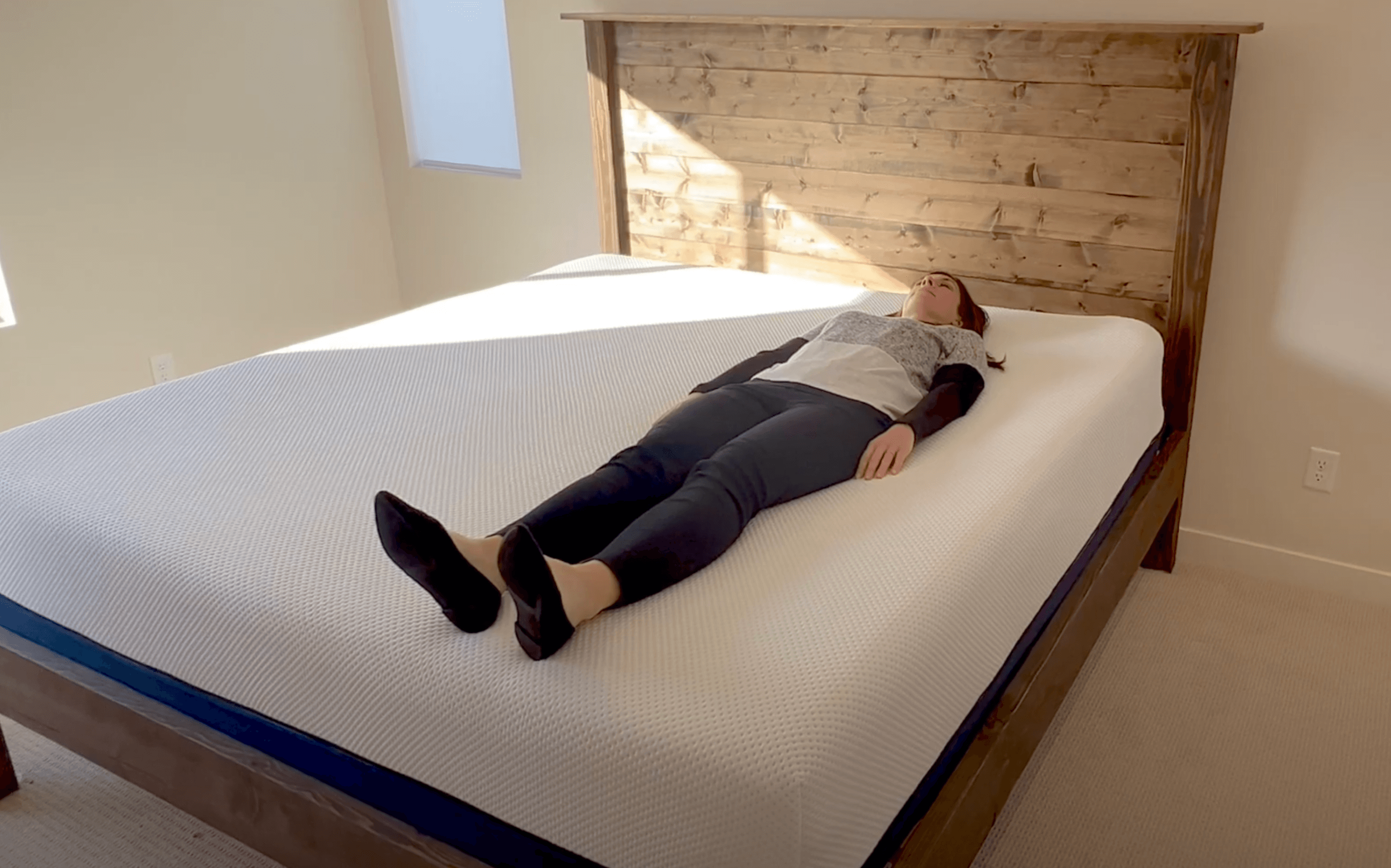
Watch Our AS5 Hybrid Video Review
Soft mattresses have a structural problem: piling on more soft foam makes the whole surface compress uniformly, the hips drop lowest, and the bed turns into a hammock that is harder to get out of than it was to get into.
The AS5 Hybrid solves that by putting a pocketed coil unit under the softness instead of more foam. The coils compress more under the heavier parts of the body and push back under the lighter ones, so the shoulder and hip settle in deeply while the spine stays level. It is the softest bed on this page by some distance and it does not sag in the middle.
The tradeoff is stated plainly because it is the reason this bed sits at number twelve rather than higher: at 8 out of 10 the response time is the slowest on this page. The foam releases later than the firmer picks here, so rolling from back to side takes more effort. On a guide ranked around ease of movement, that is a real cost.
It suits a side sleeper or a lighter sleeper who needs a genuinely deep contour at the shoulder and hip and does not need the fastest repositioning here. Anyone over roughly 250 pounds may compress through the comfort layers, and back and stomach sleepers will find it too soft.
- 8 Value
- 9 Edge Support
- 9 Trial Period
- 8 Response Time
- 9 Motion Transfer
- 10 Cooling & Breathability
The AS5 Hybrid is the softest bed on this page and it is here for one reason: some people need a genuinely soft surface, and the usual problem with soft mattresses is that they sag in the middle and make moving harder. This one does not, because there is a pocketed coil unit underneath doing the support work rather than more foam.
When I lay on my side, my shoulder and hip settled in far deeper than on anything else here, and my spine still stayed level rather than bending. The coils compress more under the heavier parts of the body and push back under the lighter ones, which is what stops the hammock effect.
The edge held up better than soft mattresses usually manage. Sitting on the perimeter with full weight, the double-density coils kept it stable rather than letting it fold.
The tradeoff is honest and it is the reason this bed sits where it does in the ranking: at 8/10 the response time is the slowest on this page. When I rolled from my back onto my side, the foam released noticeably later than on the firmer picks here. If moving with minimal effort is the priority, this is not the bed.
Best For:
- Side sleepers who want a deep shoulder and hip contour
- Lighter sleepers who find most mattresses too firm
- Anyone who has been told a soft bed means a sagging bed
Compare Instead:
- Amerisleep AS3 if you want easier repositioning in a medium feel
- Nolah Evolution if you want a plush option that also comes in firmer versions
- Saatva Classic if you want the Plush Soft feel with far quicker surface rebound
This is a genuinely soft bed. Lying down, the Bio-Pur layer lets the shoulder and hip settle in noticeably deeper than anything else on this page.
On my side that depth worked: the shoulder settled in without being pushed back on, and the coils underneath kept the hip from continuing down, so my spine stayed level. On my back my hips sat slightly lower than my shoulders. Stomach sleepers will find it too soft.
The cover felt cool on first contact and the surface warmed more slowly than the denser foam beds I compared, which is what its 10/10 for cooling reflects.
Changing position is where this bed asks the most of you. The foam releases later than on the firmer picks here, so rolling from back to side took a beat longer and more effort. The coils help, but they are working against 14 inches of soft build.
Sitting on the edge, the double-density perimeter coils kept it stable under full weight, better than most soft mattresses manage.
The AS5 Hybrid is a 14-inch build, and the pocketed coil unit is what makes a soft mattress work here rather than sag. The coils compress more under heavier regions and push back under lighter ones, and that differential is what kept my spine level on my side while my shoulder and hip settled in far deeper than on any other bed on this page. A soft all-foam build compresses uniformly and drops the hips; this one does not.
The Bio-Pur comfort foam above is the layer producing that depth. It is also the layer responsible for the bed’s weakest score: it releases later than the firmer foams here, which is why repositioning took a beat longer and why response time sits at 8/10.
The Active Flex layer between them is what stops the softness from continuing all the way down. It holds the lower back up as the foam above compresses, so the surface reads soft without turning into a dip.
The double-density perimeter coils are why the edge stayed stable when I sat on it with full weight, which soft mattresses usually fail at.
The cover is where the cooling comes from: it felt cool on first contact and warmed more slowly than the denser foam beds I compared. The foams are CertiPUR-US certified and tested for low VOC emissions, and the mattress is fiberglass-free.
Pros
- Cooling and Breathability (10/10): the cover felt cool on first contact and the surface warmed more slowly than the denser foam beds I compared
- The coil unit stops the hammock effect: my shoulder and hip settled in deeply on my side while my spine stayed level
- Edge Support (9/10): the double-density perimeter coils kept the edge stable under full weight, unusual for a bed this soft
Cons
- Response Time (8/10): the lowest on this page. The foam releases later than the firmer picks here, so rolling from back to side takes more effort
- At 3 out of 10 it is too soft for stomach sleepers and most back sleepers
- Sleepers over roughly 250 pounds may compress through the comfort layers
- At 14 inches it makes for a higher step in and out of bed
On my side, my shoulder and hip settled in deeper than on anything else I tested for this guide while my spine stayed level, because the coil unit underneath compresses differentially rather than dropping the whole surface. Rolling onto my back took a beat longer than on the firmer picks here. It suits a side sleeper or a lighter sleeper who wants a genuinely soft contour and does not need the fastest repositioning on this page.

Watch Our Zoma Start Video Review
The Zoma Start is the least expensive way onto this list, and it earns its place through firmness rather than cushioning.
At 7 out of 10 it is the firmest bed here. That has a straightforward benefit for this guide: you rest on the surface rather than settling into it, so there is very little depression to push out of when you change position. The zoned transition layer underneath runs firmer through the middle and softer at the shoulder and leg sections, which keeps the hips level without pushing back at the shoulder.
It is a 10-inch all-foam build with no coils, which shapes both what it does well and where it falls short. The firmness is why the perimeter holds under full weight, since there is no deep soft layer for the edge to compress through. The depth is the limitation: at 10 inches this is the thinnest bed on the page, and heavier sleepers will feel the base foam through the comfort layers in a way they will not on the 14-inch and 15-inch picks.
It suits a back or stomach sleeper on a budget who wants a firm surface and uses the side of the bed to get in and out. Strict side sleepers will find it firm at the shoulder, and anyone toward the heavier end should look at a deeper build.
- 10 Value
- 10 Edge Support
- 9 Trial Period
- 8 Response Time
- 9 Motion Transfer
- 9 Cooling & Breathability
The Zoma Start is the least expensive way onto this list, and it earns its place on firmness rather than plushness. At 7 out of 10 it is the firmest bed here, and when I lay on my back my hips stayed level with my shoulders with no dip under the lower back at all.
That firmness is doing something useful for this guide. A softer surface lets you settle in, and settling in is what makes rolling over harder. On the Start there is very little to climb out of, because you are resting on the surface rather than in it.
The Triangulex layer beneath the comfort foam is zoned, firmer through the middle and softer at the shoulder and leg sections, which is what kept my shoulder from being pushed back on while my hips stayed up.
The edge surprised me for an all-foam bed at this price. When I sat on the perimeter with my full weight to put my shoes on, it held rather than folding under me, and it scores 10/10 for edge support. The firmness is why: there is no deep soft layer at the surface for the edge to compress through, so the perimeter behaves much like the middle.
The honest limitation is depth. At 10 inches this is the thinnest bed on the page, and heavier sleepers will feel the base foam through the comfort layers in a way they will not on the 14-inch and 15-inch picks here.
Best For:
- Back and stomach sleepers who want a firm surface that keeps hips level
- Anyone on a budget who uses the edge of the bed to sit or get in and out
- Anyone who finds softer beds make changing position harder
Compare Instead:
- Vaya Hybrid if you want a similar price with faster surface rebound and more depth
- Amerisleep AS3 if you want a medium feel rather than a firm one
- Saatva Classic if you want a firm option with a much longer trial
The Start is firm and it does not disguise it. Lying down, you rest on the surface rather than settling into it, and the gel foam gives just enough at the shoulder and hip to take the edge off the contact point.
On my back my hips stayed level with my shoulders and my lower back stayed in contact with the surface, with no gap underneath. On my stomach my hips stayed up rather than sagging. On my side my shoulder settled in only a short distance, so strict side sleepers will find it firm.
The gel foam felt cool on first contact and the surface did not warm as fast as conventional memory foam through the first hours, though without a coil layer it does not move air the way the hybrids on this page do.
Changing position took moderate effort. Because you sit on top of the surface there is little to push out of, but the comfort foam itself releases a beat slower than the fastest picks here.
Sitting on the edge, the perimeter held under full weight rather than folding, which is not what most all-foam beds do.
At 10 inches, heavier sleepers will feel the base foam through the comfort layers.
The Zoma Start is a 10-inch all-foam build with no coils, and the Triangulex zoned transition layer is the reason it is on this list. It is cut with a zoned pattern that runs firmer through the middle section and softer at the shoulder and leg sections, and that is exactly what I felt: my hips stayed level with my shoulders on my back while my shoulder still settled in rather than being pushed back on.
Above it, the perforated gel memory foam is the surface layer. Its perforations are why it felt cool on first contact and did not warm as fast as conventional memory foam through the first hours, though without a coil layer underneath the bed does not move air the way the hybrids here do.
The high-density base foam is what keeps the whole thing from bottoming out, and at 10 inches it is also the limitation: heavier sleepers will feel it through the comfort layers in a way they will not on the deeper builds on this page.
The firmness is doing double duty here. Because you rest on the surface rather than settling into it, there is very little depression to push out of when changing position. It is also why the perimeter held under my full weight when I sat on the edge: with no deep soft comfort layer at the surface, there is nothing for the edge to compress through, which is how an all-foam bed at this price earns a 10/10 for edge support.
The foams are CertiPUR-US certified and tested for low VOC emissions. The mattress is fiberglass-free.
Pros
- Edge Support (10/10): the perimeter held under my full weight when I sat on it, which almost no all-foam bed at this price manages
- Value (10/10): the lowest entry price on this page without giving up support
- On my back my hips stayed level with my shoulders with no gap under the lower back, the firmest alignment of anything I tested here
- The gel foam felt cool on first contact and did not warm as fast as conventional memory foam through the first hours
Cons
- Response Time (8/10): the comfort foam releases a beat slower than the fastest picks on this page
- At 10 inches this is the thinnest bed here, and heavier sleepers will feel the base foam through the comfort layers
- Available in one firm feel, which is firmer than most side sleepers want at the shoulder
- All-foam construction, so it does not move air the way the hybrid picks on this page do
On my back, my hips stayed level with my shoulders with no gap under the lower back, the firmest alignment of anything I tested for this guide, and sitting on the edge the perimeter held under full weight rather than folding. Because you rest on the surface rather than settling into it, there was little to push out of when I changed position. It suits a back or stomach sleeper on a budget who wants a firm surface and uses the side of the bed to get in and out, and who is under the weight range where a 10-inch bed starts to feel thin.
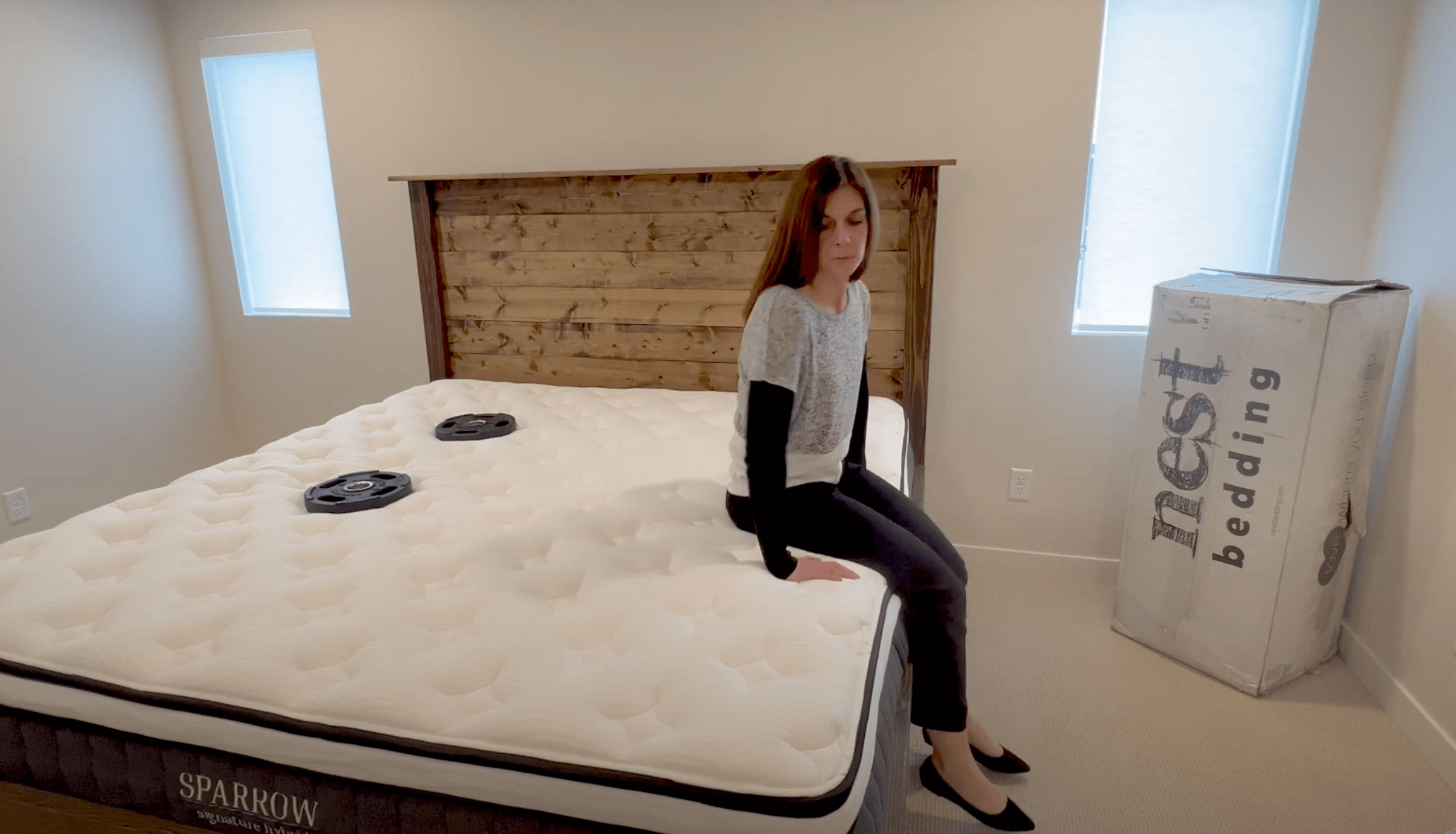
Watch Our Nest Bedding Sparrow Video Review
Two people in one bed rarely want the same thing from it. One wants enough give at the shoulder to sleep on their side; the other wants a firm surface that keeps the hips up. Most couples split the difference and neither gets what they need.
The Sparrow is the only bed on this page that does not require that compromise. On king and California king it can be built with a different firmness on each side, and the three options are genuinely different rather than variations on a theme: plush at 3, medium at 5, firm at 8. On smaller sizes you pick one feel for the whole bed.
The other reason it is here is motion. My partner shifting and getting out of bed on the far side of a queen registered almost nothing on my side, which is what its 10 out of 10 reflects. Where one person is checked on or gets up overnight, that is the difference between one person waking and two.
It suits a couple on a king or California king who need different firmness levels, particularly where one of them moves or gets up during the night. If only one person is sleeping on the bed, the split firmness is the main thing you are paying for and the AS3 covers the same ground for less.
- 8 Value
- 10 Edge Support
- 10 Trial Period
- 9 Response Time
- 10 Motion Transfer
- 9 Cooling & Breathability
The Sparrow is the only bed on this page that can be built with a different firmness on each side, and on a guide about repositioning that matters more than it sounds. If one person needs a softer surface to relieve the shoulder and the other needs a firmer one to keep hips level, you are not forced to average them into a compromise that suits neither.
Motion isolation is the other reason it is here. When my partner shifted and got out of bed on the far side of a queen, I registered almost nothing on my side, which is what its 10/10 reflects. If someone is being checked on or repositioned overnight, that is the difference between one person waking and two.
The perimeter matched it. Sitting on the edge with full weight, it stayed firm and level, a 10/10 for edge support.
The Energex comfort foam recovers quickly, closer to latex than to memory foam, so rolling from back to side did not mean pushing out of a depression.
Best For:
- Couples who need different firmness levels on each side
- Anyone sharing a bed with someone who moves or gets up overnight
- Sleepers who use the edge of the bed to sit or get in and out
Compare Instead:
- Saatva Classic if you want three firmness options without needing a king
- FORM Prime if you want the same trial length in a single-firmness build at a lower price
- Amerisleep AS3 if only one person is sleeping on the bed
How this bed feels depends on which firmness you choose, and the three are genuinely different rather than variations on a theme.
The plush side lets the shoulder and hip settle in deeply, and the coils underneath keep the hip from continuing down, so my spine stayed level on my side. The medium sits balanced: enough give at the contact points, enough support to keep hips level on my back. The firm holds you highest on the surface, with contouring only at the shoulder and hip.
On king and California king the two sides can be specified separately. On smaller sizes you pick one for the whole bed.
The phase-change cover felt cool on first contact and the surface warmed more slowly than the denser foam beds I compared through the first hours.
Changing position took modest effort. The Energex foam recovers closer to latex than memory foam, so there is little depression to push out of.
Sitting on the edge, the perimeter stayed firm and level under full weight, and my partner getting out on the far side barely registered.
The Sparrow is a 13-inch hybrid, and the Energex comfort foam is why repositioning is easy on it. Energex recovers closer to latex than to memory foam, so when I rolled from my back onto my side the surface came back rather than holding the shape I had left. It is also the layer that changes between firmness levels: the same foam is specified at different densities for the plush, medium and firm builds, which is how the split-firmness option works without stacking two different beds together.
Beneath it, the transition foam is what keeps the coil layer from being felt through the comfort foam, and it is part of why my partner’s movement did not carry across.
The pocketed coil unit does the rest of that work. Each coil is fabric-encased and compresses only where weight lands, which is what earned the 10/10 motion transfer score, and the reinforced perimeter coils are why the edge stayed firm and level when I sat on it with full weight.
The quilted phase-change cover is what the surface feels like on first contact. It felt cool when I first lay down and the surface warmed more slowly than the denser foam beds I compared through the first hours.
A high-density base foam stabilizes the coil unit so the firmness stays consistent rather than settling unevenly. The foams are CertiPUR-US certified and tested for low VOC emissions, and the mattress is fiberglass-free.
Pros
- Motion Transfer (10/10): my partner shifting and getting out on the far side of a queen registered almost nothing on my side
- Edge Support (10/10): the perimeter stayed firm and level when I sat on it with full weight
- Trial Period (10/10): 365 nights with a lifetime warranty
- Split firmness lets each side be specified separately, so two people with different needs are not averaged into one compromise
Cons
- Split firmness is only available on king and California king, so smaller sizes get a single feel throughout
- Value (8/10): priced above the foam and value-tier picks on this page
- Heavy enough that rotating it is a two-person job
My partner shifting and getting out of bed on the far side of a queen registered almost nothing on my side, and sitting on the edge with full weight the perimeter stayed firm and level. The Energex foam came back rather than holding the shape I had left when I changed position. It suits a couple on a king or California king who need different firmness levels on each side, particularly where one person moves or gets up overnight.
The Mattresses We Have Tested
Every mattress below was tested hands-on and on camera by me, Kristina Hindes, our lead tester. Each row links to its written review and filmed test, so you can check our work. For how we score every mattress, see How We Test Mattresses.
See the full list, with review and video links
| Mattress | Review and video |
|---|---|
| Amerisleep AS2 | Review · Video |
| Amerisleep AS3 | Review · Video |
| Amerisleep AS3 Hybrid | Review · Video |
| Amerisleep AS5 | Review (test clips inside) |
| Amerisleep AS5 Hybrid | Review · Video |
| Amerisleep AS6 Black Series | Review · Video |
| Amerisleep Organica | Review · Video |
| Amerisleep Organica Plush | Review · Video |
| Bear Original | Review · Video |
| Birch Natural | Review · Video |
| Brooklyn Bedding Aurora Luxe Hybrid | Review · Video |
| Brooklyn Bedding Plank Firm | Review · Video |
| Casper The One | Review · Video |
| Eco Terra Hybrid Latex | Review · Video |
| FORM Core | Review · Video |
| FORM Core Hybrid | Review · Video |
| FORM Prime | Review · Video |
| FORM Prime X | Review · Video |
| GhostBed Flex | Review · Video |
| Happsy Organic | Review · Video |
| Helix Dawn Luxe | Review · Video |
| Helix Midnight Luxe | Review · Video |
| Helix Sunset Luxe | Review · Video |
| Latex For Less Hybrid | Review · Video |
| Leesa Original | Review · Video |
| Leesa Sapira Chill Hybrid | Review · Video |
| Leesa Sapira Hybrid | Review · Video |
| Naturepedic Concerto | Review · Video |
| Naturepedic EOS Classic Organic | Review · Video |
| Nest Bedding Owl | Review · Video |
| Nest Bedding Puffin Kids | Review · Video |
| Nest Bedding Raven | Review · Video |
| Nest Bedding Sparrow Signature Hybrid | Review · Video |
| Nolah Evolution 15 | Review · Video |
| Nolah Natural 11 | Review · Video |
| Nolah Original Hybrid | Review · Video |
| PlushBeds Botanical Bliss | Review · Video |
| PlushBeds Luxury Bliss | Review · Video |
| PlushBeds Organic Bliss | Review · Video |
| PlushBeds Organic Kids | Review · Video |
| PlushBeds Signature Bliss | Review · Video |
| Saatva Classic | Review · Video |
| SweetNight CoolNest | Review · Video |
| SweetNight Prime | Review · Video |
| Vaya Hybrid | Review · Video |
| Vaya Mattress | Review · Video |
| Westin Heavenly Bed | Review · Video |
| Zoma Boost | Review · Video |
| Zoma Hybrid | Review · Video |
| Zoma Start | Review · Video |
What Bed Sores Are
Bed sores, also called pressure sores or pressure ulcers, are wounds that form when the same area of skin is under sustained pressure for too long. Body weight presses the skin against the bone underneath, blood cannot reach the tissue, and damage begins. They form most often over bony areas with little padding: the tailbone, heels, hips, shoulder blades, and the back of the head.
Pressure is not the only factor. Sliding down in bed drags the skin in one direction while the bone underneath moves in another, and skin rubbing against sheets wears the surface layer. Moisture makes skin softer and easier to damage. All of these are worse the longer someone stays in one position.
Which is why changing position regularly is the single most important thing anyone can do, and why this guide ranks mattresses the way it does. A bed that is hard to move on works against the one intervention that matters most.
Before You Shop: What a Mattress Can and Cannot Do
One thing worth being direct about. Everything on this page is about mattresses as comfort and mobility surfaces. It is not medical guidance, and a mattress is not a treatment.
If there is an existing wound, or a doctor or nurse has said someone is at risk for pressure injuries, the support surface decision belongs with them. They may prescribe an alternating pressure or low air loss system. Those are a different category of product, they are often covered by insurance with a prescription, and no consumer mattress replaces one.
What a good mattress can do is make repositioning easier, give you a stable edge to sit on, and keep one person’s movement from waking the other. Those are real and they matter. They are not the same as treating a wound. If you are not sure which situation you are in, ask before you buy.
What to Look For in a Mattress
Ease of Movement
This is the one to weigh most heavily. If someone is being repositioned every couple of hours, or repositioning themselves, the mattress either helps or gets in the way.
What to look for: a surface that returns to shape quickly when weight comes off it, rather than holding a body impression you have to push out of. Coil and latex beds tend to do this best. Slower memory foam tends to do it worst.
How to test it: press your hand into the surface and lift it. Watch how long the impression takes to disappear. Then lie down, roll from your back onto your side, and notice whether you had to push out of a dip to get there.
Edge Support
Getting in and out of bed happens at the perimeter, not the middle. An edge that compresses under you is a stability problem before it is a comfort one, and it also costs you usable sleeping surface.
What to look for: reinforced perimeter coils, a dense foam encasement, or a firm overall build. Soft pillow tops are the usual weak point unless the border coils are specifically reinforced.
How to test it: sit on the edge with your full weight, the way you would putting on shoes. It should hold roughly level rather than folding or tipping you toward the middle.
Pressure Redistribution
A mattress spreads body weight across a wider area so no single point carries all of it. Contouring materials do this by molding around the shape of the body rather than meeting it at a few high points.
What to look for: multiple foam layers of differing firmness, zoned support that is softer at the shoulder and firmer through the middle, or a pocketed coil unit where each coil responds independently.
How to test it: press a hand into the surface. It should sink smoothly and spread the pressure across the whole hand rather than compressing in one spot.
Support Without Bottoming Out
A bed can be soft and still supportive. Bottoming out means compressing far enough that you feel the hard base underneath, which defeats the point.
What to look for: enough total depth for the body weight it is carrying, and a firm base layer beneath the softer comfort layers. Heavier sleepers need more depth than lighter ones.
How to test it: lie down and slide a hand under the lower back, hips and heels. You should not feel the frame.
The Right Firmness
Firmness has to match body weight and sleeping position, and there is no single correct answer.
Side sleepers generally need medium to medium-soft, because the shoulder and hip carry concentrated weight and a firm surface pushes back at them. Back sleepers generally do well at medium to medium-firm, which supports the lower back while still cushioning the shoulder blades and tailbone. Stomach sleepers need firmer support to keep the hips from dropping below the shoulders. Combination sleepers need a surface that works reasonably in every position, which usually means the middle of the range.
Body weight shifts all of that. Under about 130 pounds, most beds feel firmer than their rating suggests, so softer is usually better. Between 130 and 230 pounds, medium to medium-firm suits most people. Over 230 pounds, firmer builds with stronger support hold up better and resist bottoming out.
The wrong firmness fails in one of two directions. Too firm and there is not enough give at the contact points. Too soft and moving becomes difficult, which is the failure that matters most here.
Moisture and Heat
A surface that traps heat and moisture is less comfortable and, over long periods of contact, less pleasant to lie on.
What to look for: breathable cover fabrics, airflow through a coil layer or perforated foam, and moisture-wicking materials. Wool and cotton handle moisture well. Coil beds move more air than solid foam.
Practical Considerations
Size and Compatibility
Measure the frame before ordering. Check whether the mattress works with an adjustable base if you have one, since some builds do not flex. If the bed uses rails, very thick mattresses can sit too high for them to be effective, and profile height affects how easy the bed is to get in and out of. Weight capacity is worth checking directly with the brand, since exceeding it usually voids the warranty.
Mattress Type
Memory foam contours closely and distributes weight well, but slower formulations can make changing position harder and some sleep warm.
Latex is more responsive. It springs back quickly, sleeps cooler than most memory foam, and lasts a long time, though it contours less closely and costs more.
Hybrids combine foam or latex comfort layers over a coil unit. The coils add airflow, edge stability, and quicker response, which is why most of the picks on this page are hybrids.
Innersprings are the most responsive and easiest to move on. Quality varies enormously; a well-built innerspring with a substantial pillow top performs very differently from a basic one.
Cost and Durability
The picks on this page run from a few hundred dollars to a few thousand. Higher price generally buys depth, better edge reinforcement, longer trials and longer warranties rather than a fundamentally different experience.
Trial length deserves more weight here than it usually gets. This is often an urgent purchase made without a chance to try the bed first, and a mattress that turns out to be wrong for the person using it is only fixable if you can return it. Two picks on this page offer 365 nights. One offers none at all.
Durability matters for the same reason. A bed that develops soft spots stops doing the thing you bought it for, and replacing it is both expensive and disruptive.
Questions to Ask Before Buying
About the mattress: What is the weight capacity? How thick is it? Is the cover removable and washable? What does the warranty actually cover, and for how long? How long does the brand expect it to last?
About the company: What is the return policy, and is there a trial period? Is delivery and setup included, or extra? Do they remove the old mattress? What happens if something goes wrong?
About your situation: Will it fit the frame? Is the height workable for getting in and out? Can it be rotated by the people who will be living with it?
Red Flags
Be cautious if the price seems too good to be true, if there is no clear return policy, if the seller pressures you to decide immediately, if no warranty is offered, or if they cannot tell you the weight capacity or what the mattress is made of.
Be especially cautious of any seller who claims a mattress will cure or heal bed sores. No consumer mattress does that, and a seller who says otherwise is telling you something about themselves.
Beyond the Mattress
A mattress is one part of a larger picture, and it is not the most important part.
Changing position regularly is what actually reduces sustained pressure, and standard healthcare guidance is roughly every two hours for people at risk. How that is done, how often, and what else needs to happen alongside it are questions for a doctor or wound care nurse rather than a mattress guide. They can also advise on skin monitoring, nutrition, moisture management, and seating, all of which matter and none of which a mattress addresses.
What you can take from this page is which of these beds makes the moving part easier.
FAQs
What should I actually look for in a mattress for someone at risk of bed sores?
Three things, in this order. Response time, meaning how quickly the surface comes back when you change position, because a bed that is hard to move on works against repositioning. Edge support, because getting in and out of bed happens at the perimeter. And motion transfer, because a bed that carries movement across it wakes the other person every time someone is checked on. The Amerisleep AS3 scored best on that combination across the 50+ mattresses I tested.
What is a pressure relief mattress and how is it different from a regular mattress?
A pressure relief mattress is specially designed to reduce pressure on your body, especially your bones, to prevent bed sores. Regular mattresses don’t spread your weight as evenly and can create pressure points that lead to painful sores.
How do I know what type of mattress I need?
It depends on how much the person can move and their risk of getting bed sores. Talk to a doctor or nurse who can check the person’s skin and movement to recommend the right mattress.
Do I still need to turn someone every 2 hours if they have a pressure relief mattress?
Yes, you should still turn and reposition the person regularly, though your doctor might say you can do it less often. No mattress completely removes the need to change positions.
How much does a good pressure relief mattress cost?
Basic foam mattresses start around $200-$500, while more advanced air mattresses can cost $1,000-$3,000 or more. You can also rent them for $100-$300 per month.
Will Medicare or insurance pay for a pressure relief mattress?
Medicare and many insurance plans will cover pressure relief mattresses if a doctor says they’re medically necessary. You’ll need a prescription and documentation showing the person is at risk for bed sores.
What’s the difference between foam, air, and gel mattresses for bed sores?
Foam mattresses are the simplest and use special foam to cushion pressure points. Air mattresses have air cells that can be adjusted for firmness and some alternate pressure by inflating and deflating. Gel mattresses use gel layers to spread weight evenly and stay cooler.
How long does it take for a bed sore to develop?
Pressure ulcers can begin forming within 2-3 hours of sustained pressure on vulnerable areas. Stage 1 damage (non-blanching redness) may appear within hours, while deeper tissue injury can occur even faster in high-risk patients with poor circulation, malnutrition, or existing health conditions.
The “2-hour repositioning rule” exists because this timeframe represents the maximum safe period before irreversible tissue damage typically begins.
Can a good mattress completely prevent bed sores?
No. No mattress does that on its own, and any seller who tells you otherwise is overselling. Repositioning, skin monitoring, nutrition and clinical care all matter, and those are managed by people rather than products. A mattress that is easy to move on supports that work; it does not replace it.
What’s the difference between a medical-grade mattress and a regular pressure-relief mattress?
Medical-grade mattresses (alternating pressure, low air loss systems) actively change pressure patterns through motorized air cells that inflate/deflate on cycles, and may include moisture-control features like air permeability.
Regular pressure-relief mattresses (advanced foam, hybrids) use passive pressure redistribution through foam density, zoning, and responsive materials.
How do I know if a mattress is working to prevent bed sores?
A mattress is doing its job here if changing position is easy, the edge stays steady when you sit on it, and you are not waking up because someone else moved. Those are the things a mattress controls. Whether skin is holding up is a clinical question, and it belongs with a doctor or wound care nurse rather than a mattress review.
Do I need a special mattress if someone already has a bed sore?
Yes, and the decision is not yours to make alone. An existing pressure injury needs a clinician to specify the support surface, which is often an alternating pressure or low air loss system rather than a consumer mattress. Nothing on this page substitutes for that.
Are alternating pressure mattresses better than foam mattresses?
Alternating pressure mattresses work better for people at high risk who can’t move at all. Foam mattresses work fine for people at lower risk who can move a little on their own.
How long do pressure relief mattresses last before needing replacement?
Foam mattresses typically last 3-5 years, while air mattresses can last 5-7 years with proper care. Replace them sooner if you notice sagging, tears, or if they stop working properly.
Can I just use a mattress topper instead of buying a whole new mattress?
A topper can help for mild cases or preventing bed sores, but it won’t work for someone at high risk or who already has sores. For serious needs, you’ll need a full pressure relief mattress.
What else do I need besides a pressure relief mattress?
You’ll also need special pillows to cushion heels and elbows, a turning schedule, regular skin checks, good nutrition, and keeping the skin clean and dry. The mattress is just one part of preventing bed sores.
Conclusion
The mattresses on this list were ranked on how easy they are to move on, how steady they are at the edge, and how little movement they pass across to the other side of the bed. The Amerisleep AS3 finished first on that combination, with the Saatva Classic close behind on the strength of the fastest repositioning and the longest trial period on the list, and the Vaya Hybrid as the budget pick.
Choosing well here is mostly about matching the bed to the person who will sleep on it. Someone who reaches for the edge of the bed to stand up needs a firm perimeter more than they need a plush surface. Someone who is checked on overnight needs low motion transfer more than they need cooling. Someone who finds rolling over difficult should look at response time before anything else.
And if there is a wound involved, or a clinician has flagged a pressure injury risk, talk to them before you buy. The right answer in that situation may not be a consumer mattress at all.
Related Reads
- I Tested 50+ Mattresses to Find the 14 Best Mattresses for Piriformis Syndrome of 2026

- I Tested 50+ Mattresses to Find the 14 Best Mattresses for Neuropathy of 2026

- I Tested 50+ Mattresses to Find the 14 Best Mattresses for Kyphosis of 2026

- I Tested 50+ Mattresses to Find the 14 Best Mattresses for Anterior Pelvic Tilt of 2026